
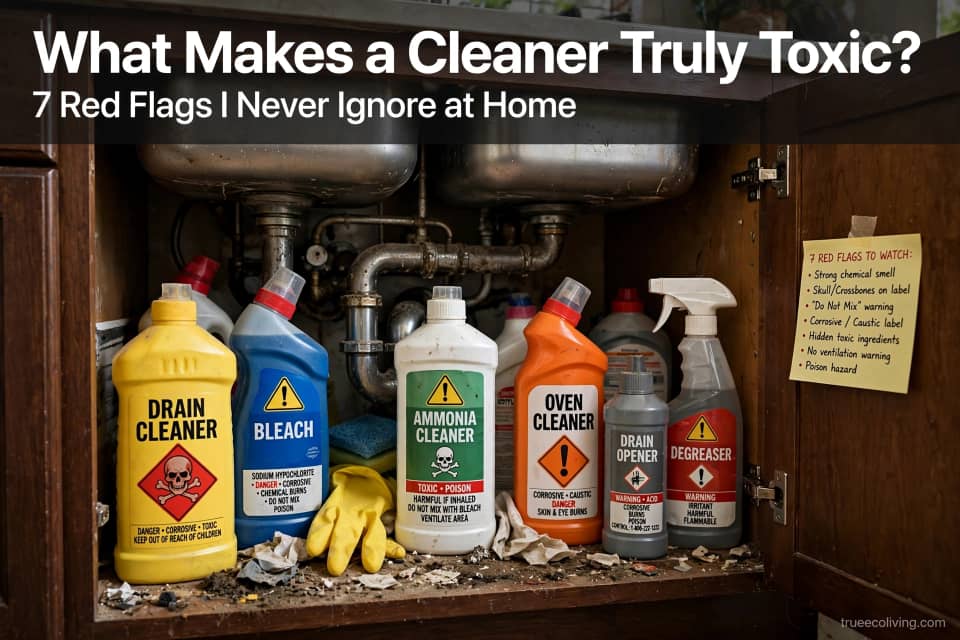
There is a big difference between a product that “smells clean” and a product that is actually a good choice for a real home. In eco-living, I do not judge a cleaner by the marketing on the bottle.
I judge it by what it can do to your air, your skin, your surfaces, your nervous system, and the people who live with you.
A cleaner becomes truly toxic when its ingredients, its fumes, or its misuse create a meaningful risk instead of a helpful result.
That risk can show up as irritation, chemical burns, asthma symptoms, indoor air pollution, or dangerous reactions when products are mixed.
The tricky part is that many cleaning products are sold as “fresh,” “powerful,” or “hospital-grade,” but those words do not tell you whether the product is gentle, low-emission, or safe for repeated use.
EPA’s Safer Choice program exists because ingredient choice matters, VOC levels matter, and fragrance can matter too.
NIOSH and CDC also continue to flag certain cleaning ingredients, especially quats, bleach, and spray products, for asthma and respiratory concerns.
What Makes a Cleaner Truly Toxic? A brief overview
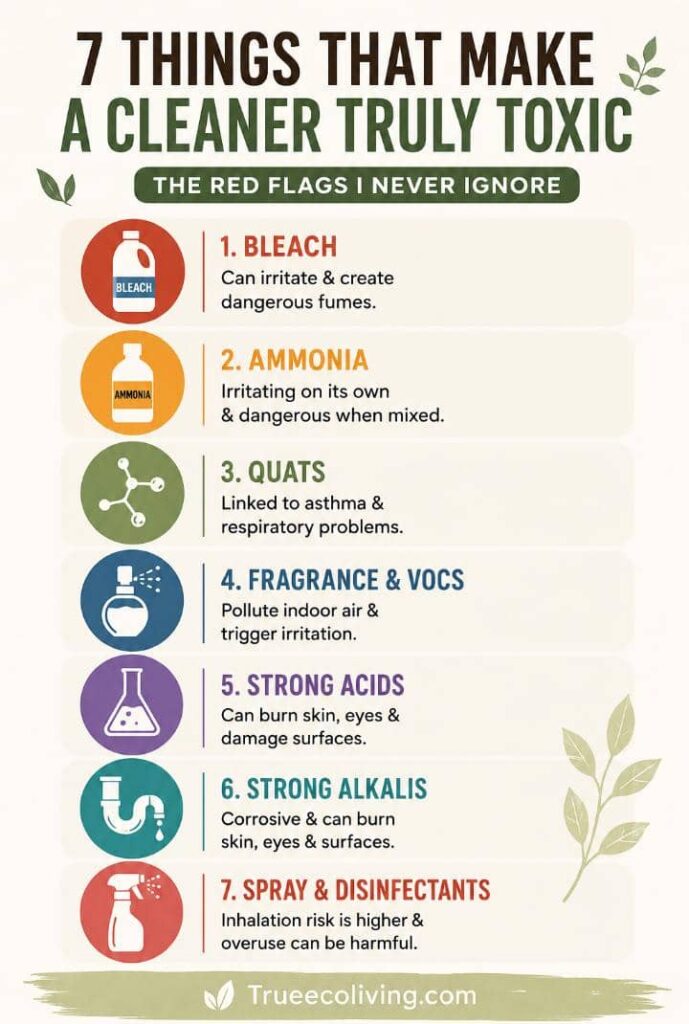
| Red flag | Why it matters | My eco-living read |
|---|---|---|
| Bleach | Can irritate skin, eyes, and lungs; dangerous fumes can form when mixed with ammonia or acids. | Useful in limited cases, but never a casual daily cleaner. |
| Ammonia | Irritating on its own and dangerous when mixed with bleach. | A classic “strong smell, strong warning” product. |
| Quats | Linked with work-related asthma and respiratory symptoms. | Often hidden inside disinfectants and “antibacterial” products. |
| VOCs and fragrance | Raise indoor air pollution and can irritate sensitive airways. | The scent is not proof of cleanliness. |
| Strong acids | Can burn skin, eyes, and surfaces, especially in toilet and descaling products. | Powerful, but not forgiving. |
| Strong alkalis | Can also burn and damage surfaces, especially drain and oven cleaners. | A hidden hazard when people “just spray and scrub.” |
| Spray format | Inhalation is easier, which raises the chance of lung irritation. | The package can be part of the problem. |
BOOKMARK: 15 Best Non Toxic Cleaning Products for a Safer and Eco Friendly Home (2026)
What Makes a Cleaner Truly Toxic?
A cleaner is not automatically toxic just because it is synthetic, and it is not automatically safe just because it is plant-based or expensive.
What makes it truly toxic is the combination of hazard and exposure. A product can be dangerous because of its active ingredients, because it releases irritating gases, because it is highly corrosive, because it gets into the air as a spray, or because it is used in the wrong way.
Toxicity is not only about what is inside the bottle. It is also about how that bottle behaves in your home.
That is why I always think in four layers: what the cleaner contains, how concentrated it is, how it is applied, and who is exposed to it.
Children, pets, people with asthma, and anyone cleaning in a small room without ventilation all face a bigger burden.
CDC and pediatric guidance consistently point to cleaning chemicals, fragrances, and poor ventilation as asthma triggers or respiratory irritants.
7 of the Biggest Toxicity Red Flags I Watch For
1) Bleach that is treated like a everyday cleaner
Bleach earns its reputation because it is powerful, but that power is exactly why it deserves caution.
EPA guidance notes that hypochlorites can release toxic chlorine if mixed with acids or ammonia, and CDC materials warn that bleach mixtures can create dangerous gases and irritate the eyes, nose, throat, and lungs.
Poison Control also warns that bleach should never be mixed with ammonia or acids. In a practical home, that means bleach belongs in a narrow lane, not a “use everywhere, all the time” lane.
What I pay attention to is not just the word bleach, but the attitude around it. If a cleaner asks you to spray, soak, and let the fumes hang in a closed room, I immediately think about respiratory strain.
Bleach is not automatically evil, but it is absolutely a red flag when it is casually used as a general-purpose cleaner.
2) Ammonia-based products
Ammonia is another classic “looks harmless until it is not” ingredient. CDC says household ammonia can release gas if mixed with certain other cleaners, and Poison Control says it should never be mixed with bleach because of chloramine gas risk.
Even on its own, ammonia can irritate the airways, skin, and eyes.
In eco-living terms, ammonia is the kind of ingredient that can make a simple cleaning job feel sharper, harsher, and less forgiving.
If a product is built around that kind of force, I see it as a “special occasion only” cleaner, not a daily-home staple.
DISCOVER: 9 Non-Toxic Cleaning Mistakes That May Be Making Your Home Dirtier Than You Think
3) Quaternary ammonium compounds, or quats
Quats are one of the most important ingredients to understand because they hide in many disinfectants and surface products.
NIOSH lists cleaning products that contain quats among work-related asthma exposures, and CDC-published research has associated quats with asthma and respiratory symptoms in workers.
CDC guidance for disinfectants and sanitizers also specifically flags bleach, quaternary ammonium compounds, and glutaraldehyde as ingredients that can trigger work-related asthma.
This is where many people get caught. They assume a disinfectant is “better” because it kills germs. But if a product makes it harder to breathe, irritates the throat, or lingers in indoor air, that is not a harmless tradeoff.
Quats are one of the clearest examples of a cleaner that can look effective on paper while being more problematic in real life.
4) Strong fragrances and VOC-heavy formulas
A lot of cleaners are sold with a “fresh” smell, but that smell can be a warning sign.
EPA notes that VOCs in cleaning products are a concern because of indoor air exposure, and Safer Choice limits VOC content to reduce indoor air pollution and respiratory concerns.
Pediatric guidance also identifies fragrances and cleaning chemicals as asthma triggers, while Healthy Children warns that strongly scented indoor products can release chemicals that harm lungs.
This is one of my personal eco-living rules: if a room smells like “product,” I do not call that clean air. I call that a fragrance burden.
The goal is not to overpower the senses. The goal is to leave the home actually clean, with the least amount of airborne residue possible.
5) Acidic cleaners that promise fast results
Acidic cleaners are often used for rust, mineral deposits, limescale, and toilet buildup. They can work extremely well, but strong acids are also corrosive.
Poison Control notes that cleaners designed to remove mineral deposits or rust may contain acids or alkalis that can cause burns.
That means the “fast action” people love can also be the same thing that makes the product risky on skin, eyes, and delicate surfaces.
My eco-living view is that acids belong in the category of controlled tools. They are not bad, but they are not casual.
The toxic part is often the mismatch between the product’s strength and the user’s expectations. People see a glossy bottle and forget they are holding a corrosive formula.
READ MORE: 5 Best Non-Toxic Shower Cleaners for Soap Scum and Everyday Grime That Actually Get the Job Done
6) Strong alkalis, especially in drain and oven cleaners
Alkaline cleaners are the opposite extreme, and they can be just as harsh. Poison Control explains that drain and grease-cutting cleaners may contain corrosives, and strong alkalis can burn the skin and eyes.
These products are designed to break down stubborn buildup, which is helpful only until they contact a person instead of a clog.
This is why I never think of a drain cleaner as a “routine” cleaner. It is an emergency tool.
If a cleaner can eat through grease, it can also be unforgiving on living tissue. That is a simple rule I trust more than any marketing promise.
7) Spray formats, aerosol clouds, and “kill everything” disinfectants
Sometimes the problem is not only the ingredient. It is the delivery system. Spray cleaners increase the chance of inhalation exposure, and CDC-linked studies have associated spray cleaning products with asthma and respiratory symptoms among workers.
EPA also notes that disinfectants are pesticides and can be harmful, which is why label directions matter so much.
This is the part most people underestimate. A spray bottle turns a liquid problem into an air problem.
And when a product is marketed as a powerful disinfectant, it can encourage overuse, even when a surface does not need that level of treatment.
In eco-living, I always ask: do we need a true disinfectant here, or do we just need soap, water, and better habits?
READ ALSO: 5 Best Non-Toxic Toilet Cleaners That Actually Work: My Eco Living Roundup for a Cleaner, Safer Bathroom
How I Judge a Cleaner in Real Life
When I am choosing a cleaner, I do not start with fragrance, foam, or how “strong” it sounds. I start with the label.
Does it contain bleach, ammonia, quats, or a corrosive acid or alkali? Does it say spray or disinfect? Does it depend on scent to feel convincing? Is the VOC load kept low? Does the brand make it easy to understand how to use it safely?
Those are the clues that matter. EPA’s Safer Choice standards and ingredient guidance are built around exactly those concerns: VOCs, safer ingredients, and clearer chemical decisions.
I also pay attention to the room itself. A product that feels “fine” in a big open space can become irritating in a tiny bathroom with no ventilation.
And a formula that seems manageable for one adult can be too much around children, asthma, or sensitive skin.
That is why the safest cleaner is often not the strongest one. It is the one that does the job with the least disruption to the air you breathe.
What I Trust More Instead
For most daily cleaning, I trust simple routines more than aggressive formulas. That usually means cleaning earlier, wiping more often, using good ventilation, picking fragrance-free or low-fragrance options where possible, and using the mildest product that still gets the job done.
EPA’s Safer Choice criteria and pediatric guidance both point toward lower VOCs, fragrance caution, and a safer ingredient mindset.
Poison Control also repeatedly emphasizes not mixing chemicals and following label directions exactly.
A cleaner should make a home healthier, not just shinier. That is the real eco-living test. If a product saves five minutes but leaves a room harder to breathe in, that is not progress.
If a formula needs three warnings, a strong odor, and perfect technique just to be used safely, I consider that a sign to step back and choose simpler.
TrueEcoLiving Note
My verdict is straightforward: the most toxic cleaners are usually not the ones with the loudest label, but the ones that combine harsh chemistry, airborne exposure, and careless use.
Bleach, ammonia, quats, strong acids, strong alkalis, VOC-heavy fragrances, and spray-driven disinfectants are the big warning signs I would never ignore. The cleaner the formula, the calmer the home usually feels.
The fewer the ingredients, the easier it is to understand the risk. The less fragrance, the better the air. The less mixing, the safer the routine. That is the eco-living standard I trust.
So when people ask me what makes a cleaner truly toxic, I do not answer with a brand name.
I answer with a pattern: anything that burns, fumes, lingers in the air, triggers asthma, or turns one mistake into a dangerous reaction deserves respect.
The safest home is not built on stronger chemicals. It is built on smarter choices.
SEE ALSO: 7 Best Plastic-Free Dishwashing Swaps That Make Your Sink Feel Cleaner Overnight
In a Nuteshel – What Makes a Cleaner Truly Toxic?
- A cleaner becomes truly toxic when it can harm your lungs, skin, eyes, or indoor air, or when it creates dangerous fumes after mixing.
- The biggest red flags are bleach, ammonia, quaternary ammonium compounds, strong fragrances and VOCs, acids, and strong alkalis. These are linked with irritation, burns, asthma, or worse.
- Spray cleaners can be a bigger problem than people think because inhalation exposure is easier, especially in poorly ventilated rooms.
- Disinfectants deserve extra respect because they are regulated like pesticides and must be used exactly as labeled.
- The safest cleaning routine is usually simple: fewer ingredients, fragrance-free when possible, lower VOCs, good ventilation, and no chemical mixing.
Conclusion
If you remember only one thing from this post, let it be this: a cleaner is truly toxic when it creates more harm than help.
That harm can come from the ingredient itself, from the fumes it gives off, from the way it is sprayed, or from the way it reacts when mixed with something else. Bleach and ammonia can create dangerous gases.
Quats can be asthma triggers. Strong acids and alkalis can burn. VOC-heavy fragrances can pollute indoor air. Disinfectants need careful handling because they are not just ordinary cleaners.
The cleaner your routine becomes, the less you have to fight your own air. And that, to me, is the real meaning of a clean home.
Not harsh. Not heavy. Just effective, understandable, and safe enough to use again tomorrow.
FAQs
No. Toxicity depends on the ingredient, concentration, exposure route, and how it is used. EPA’s Safer Choice program exists because some chemical-based cleaners are designed with safer ingredients and lower VOC concerns in mind.
Bleach is effective, but it can irritate skin, eyes, and lungs, and it can release toxic gases when mixed with ammonia or acids. That is why label directions and safe storage matter so much.
Fragrance and VOCs are often underestimated. They can raise indoor air pollution and trigger symptoms in sensitive people, especially in closed or poorly ventilated rooms.
Use the mildest product that still works, avoid mixing cleaners, ventilate the room, and favor lower-VOC or fragrance-free choices when possible. For stronger products, follow the label exactly.