
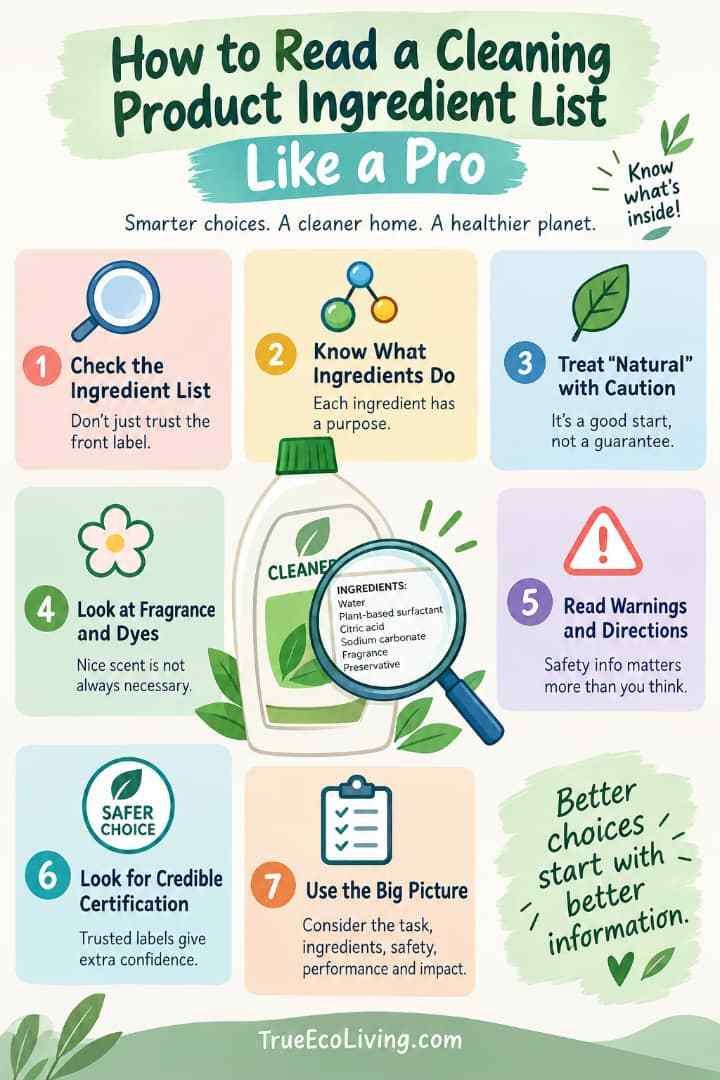
Buying a cleaning product can feel like a guessing game. One bottle promises a natural formula, another displays green leaves, and a third claims to be plant-powered. But which one actually deserves a place in your home?
I have come to appreciate one important principle in eco-friendly living: the best buying decisions start with understanding what is inside the bottle, not just what is printed on the front.
Reading an ingredient list may look complicated at first, especially when chemical names seem impossible to pronounce.
However, you do not need a chemistry degree to make more informed choices. You need to understand what common ingredients do, which claims deserve a closer look, and how the product is intended to be used.
In this guide, I will show you how I approach cleaning product labels so you can shop more confidently without becoming overwhelmed by every unfamiliar word.
5 Things to Remember When Reading Cleaning Labels
- Look beyond marketing claims: Words such as “natural,” “green,” and “plant-based” do not automatically guarantee a safer product.
- Learn ingredient functions: Surfactants, solvents, acids, and preservatives all serve different purposes.
- Pay attention to fragrance: Fragrance ingredients may matter if you are sensitive to scented products.
- Check safety instructions: Concentration, intended use, ventilation, and contact precautions matter.
- Choose transparency: Prefer products that clearly disclose their ingredients and provide credible safety information.
Cleaning Product Ingredient Roundup: What Should You Look For?
| Ingredient or label term | What it does | What I look for |
|---|---|---|
| Surfactants | Help lift grease and dirt from surfaces | Clear ingredient disclosure and a suitable cleaning purpose |
| Solvents | Help dissolve grease, oils, and other residues | Information about the formula and directions for use |
| Citric acid | Helps tackle mineral deposits and some hard-water stains | Whether the product is suitable for the surface |
| Sodium carbonate | Helps boost cleaning and deal with greasy soil | Appropriate concentration and handling instructions |
| Enzymes | Help break down certain organic stains | Clear use instructions and relevant precautions |
| Fragrance or parfum | Adds scent or masks other odours | Whether fragrance ingredients are disclosed and whether scent is necessary |
| Preservatives | Help prevent microbial growth in water-based products | Transparent ingredient information and proper use guidance |
These ingredients are not automatically good or bad in every situation. Their safety depends on factors such as formulation, concentration, exposure, and intended use.
BOOKMARK: 15 Best Non-Toxic Cleaning Products for a Safer and Eco Friendly Home (2026)
1. Start With the Ingredient List, Not the Front Label
One mistake I encourage people to avoid is treating a beautiful package as proof of a better formula.
A green label, botanical illustration, or “eco-friendly” claim might catch your eye, but these features do not tell you everything about the product’s ingredients or environmental impact.
I start by turning the bottle around and looking for an ingredient list. If the list is missing or confusing, I check whether the manufacturer provides more information online.
This matters because ingredient disclosure requirements differ between countries and product categories. In some markets, cleaning product manufacturers are not required to disclose every ingredient on the container.
My rule is simple: the easier it is to find meaningful ingredient information, the easier it is to make an informed decision.
I also look for specific descriptions instead of relying entirely on phrases such as “clean formula” or “made with nature in mind.”
2. Learn the Job Behind Common Ingredient Names
When I first look at an ingredient list, I do not ask whether every ingredient sounds natural. I ask what each ingredient contributes to the formula.
For example, surfactants help water interact with oils and dirt, making grime easier to remove. Solvents help dissolve certain residues, while chelating agents bind minerals that can interfere with cleaning performance.
Acids, such as citric acid, can help loosen mineral deposits. Alkaline ingredients, including sodium carbonate, can help with greasy soil. Enzymes break down particular types of organic stains.
Preservatives have another important job: they help protect certain formulas from microbial growth during storage and use.
Understanding these functions changes how I assess a product. An ingredient is not automatically undesirable because its name sounds technical. Equally, an ingredient does not become harmless simply because its name sounds familiar.
I focus on the ingredient’s purpose, how the complete formula works, and whether the manufacturer provides useful safety information.
READ ALSO: What Makes a Cleaner Truly Toxic? 7 Red Flags I Never Ignore at Home
3. Treat “Natural,” “Non-Toxic,” and “Plant-Based” as Starting Points
These are some of the most persuasive words on cleaning product packaging, but I never treat them as a substitute for evidence.
A plant-derived ingredient can still cause irritation or trigger a sensitivity. Essential oils, for example, are natural substances, but that does not mean everyone will tolerate them equally well.
Likewise, a synthetic ingredient is not automatically dangerous simply because it was manufactured rather than extracted from a plant.
I prefer a more balanced approach. I look for transparent ingredients, relevant safety information, effective performance, and a formula suited to the cleaning task.
I also distinguish between hazard and risk. Hazard describes an ingredient’s potential to cause harm under certain circumstances. Risk considers the likelihood of that harm occurring under actual exposure conditions.
This distinction matters because an ingredient’s name alone rarely tells the complete story.
When I see a vague safety promise, I look for evidence supporting it rather than making a decision based on reassuring words.
4. Look Closely at Fragrance and Dyes
A pleasant fragrance can make a room smell freshly cleaned, but a pleasant smell is not proof that a product cleans better.
I consider whether a scented formula offers a real advantage over an unscented alternative. If I am choosing a product for someone who prefers to minimise fragrance exposure, a clearly labelled fragrance-free option may be worth considering.
However, I do not assume that every scented product is unsafe or that every fragrance-free formula is automatically safer in every respect.
Fragrance mixtures can also make it difficult to identify individual scent ingredients when disclosure is limited.
Dyes deserve a similar question: are they necessary for the cleaning task, or are they mainly decorative?
My approach is to avoid unnecessary extras when a simpler product performs just as well. This is a preference for informed, practical choices, not a claim that every fragrance or colourant is harmful.
5. Pay Attention to Warnings and Directions
The ingredient list is only one part of the label. I also read the instructions, warning statements, first-aid guidance, and storage advice.
Words such as “Danger,” “Warning,” or “Caution” should never be ignored. Their meanings depend on the applicable labelling system, but they signal that the product’s hazards and handling instructions deserve attention.
I check whether the cleaner needs dilution, whether gloves are recommended, and whether the directions require ventilation. I also confirm that the product is designed for the surface I intend to clean.
One safety rule I never overlook is never mix cleaning products unless their instructions explicitly establish that doing so is safe. In particular, mixing bleach with ammonia or acidic cleaners can release dangerous gases.
A concentrated cleaner may offer good value, but only when it is handled and diluted exactly as directed. More product does not necessarily mean better cleaning.
READ MORE: 5 Best Non-Toxic Kitchen Degreasers That Actually Cut Grease (Without the Harsh-Cleaner Overload)
6. Look for Credible Certification and Better Disclosure
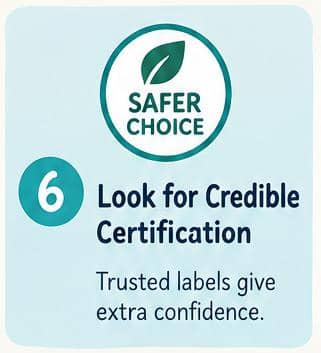
Sometimes a label does not give me enough information to judge the full formulation. That is when independent standards can help.
The program evaluates ingredients against established human-health and environmental criteria. It also considers other aspects of qualifying products, including performance and packaging.
I consider this more meaningful than an unsupported claim that a cleaner is “green.” However, Safer Choice is a US programme, so its label may not appear on products sold in every country.
Certification is a helpful screening tool, not a reason to ignore directions or assume that a product is appropriate for every person, surface, or use.
I also look for an accessible ingredient list, straightforward dilution instructions, and a manufacturer that explains what its formula is designed to do.
7. Make Your Decision Using the Whole Picture
By this point, you may be tempted to spend an hour investigating every ingredient in every bottle. I would not recommend that approach.
Instead, I use a short decision process.
First, I identify the task: am I cleaning greasy kitchen surfaces, removing bathroom mineral deposits, or washing laundry? Then I check whether the formula suits that job.
Next, I consider the ingredients, fragrance, relevant warnings, packaging, and the amount required per use.
Finally, I compare performance and value. A concentrated product is not necessarily the better choice if it is difficult to measure correctly or does not perform well for the intended task.
I also consider environmental factors such as refill availability, packaging waste, and the product’s credible environmental claims. A cleaner’s overall footprint involves more than its ingredient list alone.
My goal is not to find a mythical product with no chemicals. Everything made of matter consists of chemicals.
My goal is to choose products with understandable ingredients, appropriate safety information, reliable performance, and a reasonable environmental impact.
READ MORE: 5 Best Non-Toxic Toilet Cleaners That Actually Work: My Eco Living Roundup for a Cleaner, Safer Bathroom
TrueEcoLiving Verdict
I believe reading cleaning product ingredient lists is one of the most useful habits you can develop when building a more conscious home.
You do not have to memorise complicated chemical names or automatically reject every unfamiliar ingredient.
Instead, learn what the ingredients do, question vague marketing claims, read warnings carefully, and favour manufacturers that are transparent about their formulas.
I also remind myself that sustainable living is not about achieving perfection with every purchase. It is about making better-informed decisions consistently.
The next time you pick up a cleaning spray or laundry detergent, pause before trusting the front label. Turn the bottle around, read the instructions, and investigate anything that genuinely concerns you.
A more conscious home begins with informed choices, not fear of ingredients.
Frequently Asked Questions
Requirements vary by country and product type. Some products provide detailed ingredient lists on their packaging or websites, while others disclose limited information. Check the applicable local requirements and the manufacturer’s disclosures before making assumptions.
No. Natural ingredients can still cause irritation, sensitivity, or other unwanted effects. Safety depends on the ingredient, formulation, concentration, exposure, and how the product is used.
Start with ingredients relevant to your needs, such as fragrance if you prefer unscented products, and the active ingredients that perform the intended cleaning task. Always read the product’s warnings and directions rather than judging safety by ingredient names alone.
Look for specific ingredient information, credible certification where available, clear safety instructions, suitable cleaning performance, and reasonable packaging choices. Avoid relying on words such as “green” or “natural” without supporting information.