

Grease has a sneaky way of taking over a kitchen. One minute, your stovetop looks reasonably clean, and the next, there is a sticky film around the burners, splashes on the backsplash and a greasy layer on the cabinet doors.
I’ve always believed that keeping a kitchen clean should not mean choosing the strongest-smelling product on the shelf.
A powerful fragrance does not automatically mean better cleaning, and a product labelled “natural” is not automatically the safest choice for every household.
That is why I look beyond marketing claims when comparing kitchen degreasers.
I pay attention to the ingredients, how the formula is designed to tackle grease, whether the manufacturer explains its ingredients clearly and whether the packaging supports a more sustainable cleaning routine.
After reviewing and using some of a broader group of about 14 products, I narrowed this roundup to five options worth considering. They are not identical, and that is precisely the point.
Some are better for everyday stovetop splashes, while others make more sense when grease has built up over time.
5 Best Non-Toxic Kitchen Degreasers at a Glance
- AspenClean Kitchen Cleaner: My overall pick for grease-focused kitchen cleaning.
- ATTITUDE Kitchen Cleaner: A practical option for everyday stovetop and countertop messes.
- Branch Basics Concentrate: Best for fragrance-free cleaning and reducing single-use spray bottles.
- Simple Green All-Purpose Cleaner: A concentrated option for tougher cleaning jobs, with EPA Safer Choice recognition.
- Method Heavy Duty Degreaser: A convenient ready-to-use option for stubborn grease, with ingredient-related caveats worth considering.
| Product | Best for | Main advantage | Main consideration |
|---|---|---|---|
| AspenClean Kitchen Cleaner | Overall kitchen cleaning | Grease-focused formula and EWG Verified status | Contains fragranced essential oils |
| ATTITUDE Kitchen Cleaner | Everyday grease | EWG Verified and refill options | Contains fragrance |
| Branch Basics Concentrate | Fragrance-free cleaning | One concentrate for multiple cleaning tasks | Requires correct dilution |
| Simple Green All-Purpose Cleaner | Heavier household grease | Concentrated formula and Safer Choice recognition | Follow dilution and surface directions |
| Method Heavy Duty Degreaser | Stubborn stovetop messes | Ready-to-use formula designed for tough grease | Contains fragrance and isothiazolinone preservatives |

How I Chose These Five Kitchen Degreasers
I considered five things: ingredient transparency, suitability for greasy kitchen surfaces, fragrance and preservative choices, third-party screening where available, and packaging or refill options.
One thing I always keep in mind is that “non-toxic” is not a guarantee that a product is harmless in every situation.
Even plant-derived cleaners can irritate the eyes or skin, and certain essential oils and fragrances can be troublesome for sensitive individuals.
I also distinguish between a product company’s cleaning claims and independent evidence. For example, the US Environmental Protection Agency’s Safer Choice standard evaluates product ingredients against health and environmental criteria.
That is a useful screening tool, although it does not mean a product is chemical-free or appropriate for every surface.
BOOKMARK: 5 Best Non-Toxic Dishwasher Tablets for a Lower-Waste Kitchen (That Actually Clean)
With that in mind, here are the five cleaners I would put on a kitchen-cleaning shortlist.
1. AspenClean Kitchen Cleaner: Best Overall

When choosing a kitchen degreaser, I like seeing a formula designed specifically for the kind of grime that builds up around cooking areas.
AspenClean Kitchen Cleaner is formulated to tackle grease and grime on washable kitchen surfaces, including stovetops, appliances and countertops.
Its published ingredients include coconut-derived surfactants, sodium carbonate, sodium citrate, alcohol and potassium hydroxide.
I pay attention to this combination because a degreaser needs to do more than make a surface smell fresh. Surfactants help loosen oily soil so it can be wiped away, while alkaline ingredients can help with greasy residues.
Another plus is its EWG Verified status, along with the manufacturer’s emphasis on plant-derived ingredients and organic essential oils.
I also like that AspenClean provides a detailed ingredient list rather than relying entirely on vague descriptions such as “clean formula.”
Why I would choose it: It brings together a grease-focused formula, ingredient transparency and environmental considerations in one product.
What I would watch: The bergamot and grapefruit essential oils contribute fragrance. Naturally derived does not mean allergen-free, so this might not be my first choice for someone who reacts to fragranced cleaners.
For regular cooking splashes and greasy surfaces, this is my first product to investigate.
2. ATTITUDE Kitchen Cleaner: Best for Everyday Grease

I like the idea of a cleaner that can deal with the mess left behind after preparing dinner without requiring a separate product for every small task.
ATTITUDE Kitchen Cleaner is designed to remove grease and grime from kitchen counters and appliances.
Its listed ingredients include non-ionic surfactants such as myristyl glucoside, caprylyl glucoside and lauryl glucoside, alongside ingredients including sodium carbonate and sodium hydroxide.
The product is EWG Verified, and the manufacturer offers refill formats. I consider refill availability a practical environmental advantage because it can help reduce the need to purchase a completely new spray bottle each time.
For everyday cleaning, I look at this option when grease is still relatively fresh rather than waiting until splashes have accumulated for weeks.
Why I would choose it: It combines a kitchen-specific cleaning purpose with ingredient disclosure and refill options.
What I would watch: The formula contains fragrance. It is not my preferred choice for someone specifically seeking an unscented cleaner, and older, burnt-on residue may require additional time and scrubbing.
My advice is simple: use a kitchen degreaser regularly, and you will generally have less accumulated grime to deal with later.
DISCOVER: 10 Best Non-Toxic and Eco-Friendly Kitchen Cleaning Products That Actually Works
3. Branch Basics Concentrate: Best Fragrance-Free Option
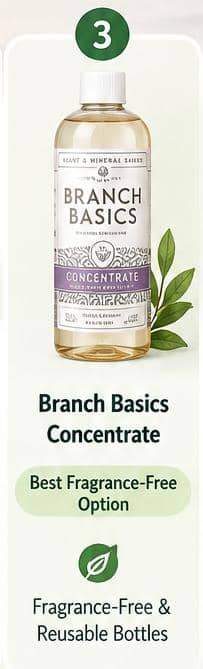
Not everybody wants a citrus or floral fragrance lingering around the kitchen after cleaning. I think that is a reasonable preference, particularly for households that choose to avoid added fragrance.
Branch Basics Concentrate takes a different approach from a conventional ready-to-use spray.
You dilute the concentrate according to the manufacturer’s instructions, creating a cleaning solution for different household tasks.
Its published ingredient list includes water, decyl glucoside, coco-glucoside, chamomile flower extract, sodium citrate, sodium bicarbonate and sodium gluconate. The formula is fragrance-free and EWG Verified.
I appreciate the straightforward ingredient disclosure and the ability to reuse spray bottles.
From a practical sustainability perspective, buying a concentrate and reusing the same bottle can reduce packaging compared with repeatedly buying individual ready-to-use sprays.
It is also an interesting option for people who prefer to maintain a smaller collection of cleaning products rather than a crowded cupboard of specialized bottles.
Why I would choose it: Fragrance-free formulation, reusable-bottle potential and versatility across household cleaning tasks.
What I would watch: Dilution matters. More concentrate does not automatically mean better results, so I would follow the product’s dilution instructions rather than improvising a stronger mixture.
For heavily baked-on stovetop grime, allow adequate cleaning time and use an appropriate non-scratch cleaning tool.
This is the option I would investigate first when avoiding fragrance is a priority.
4. Simple Green All-Purpose Cleaner: Best Concentrated Option for Tougher Cleaning
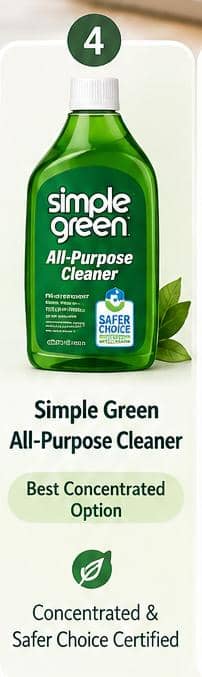
Sometimes a kitchen needs more than a quick wipe. Grease can accumulate on range hoods, cabinet surfaces and areas close to frequently used burners.
Simple Green All-Purpose Cleaner is a concentrated cleaner designed to remove dirt, grease and stains.
It is a product recognized by the EPA Safer Choice program and provides directions for using the product at different strengths, including for heavier messes.
What interests me here is the combination of concentration and versatility. A concentrated product may offer better value over multiple cleaning sessions than repeatedly buying ready-to-use bottles, depending on the dilution rate and local price.
I would consider it for households that need a versatile cleaner for several surfaces, rather than a product used exclusively on the stovetop.
Why I would choose it: Concentrated cleaning, versatility and third-party Safer Choice recognition.
What I would watch: Read the label carefully before applying it to a kitchen surface. Use the recommended dilution, check surface compatibility and follow any rinsing instructions for food-contact areas.
I would not interpret Safer Choice recognition as permission to ignore the label. Safe use still depends on how the product is handled.
EXPLORE: 7 Best Plastic-Free Dishwashing Swaps That Make Your Sink Feel Cleaner Overnight
5. Method Heavy Duty Degreaser: Best Ready-to-Use Option for Stubborn Grease
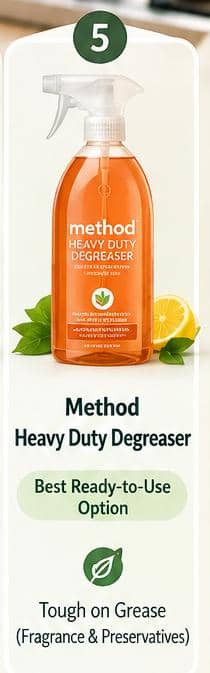
There is a practical difference between a light film of cooking oil and stubborn grease that has had repeated opportunities to build up around a stovetop.
Method Heavy Duty Degreaser is specifically marketed for tougher kitchen messes, including grease, food splatters and burnt-on residue.
The manufacturer lists stovetops, range hoods, microwaves, burners, grates, drip pans and other cooking-area surfaces among its intended uses.
Its ingredient list includes alcohol denat., surfactants, citric acid, potassium hydroxide, sodium carbonate, benzisothiazolinone, methylisothiazolinone and fragrance.
I include it because a realistic buying guide should consider cleaning performance and convenience as well as ingredient preferences.
A ready-to-use product removes the mixing step and is easier to reach for when the stovetop needs attention after a busy cooking session.
However, I would not automatically put it ahead of the other products on ingredient considerations.
Why I would choose it: It is ready to use and is specifically designed to tackle tougher grease.
What I would watch: The formula contains fragrance and isothiazolinone preservatives, which can be relevant for people susceptible to contact allergies or irritation.
It would not be my first choice for someone looking for the simplest fragrance-free ingredient profile.
For a household prioritizing stronger grease removal and convenience, it is worth comparing with the other products, provided its ingredients and instructions suit the user.
How I Approach Greasy Stovetop Messes
Regardless of which cleaner I select, I pay attention to how I use it. A good formula cannot compensate for applying the wrong product to the wrong surface.
First, I let the stovetop cool completely. I then apply the product according to its label and allow the recommended contact time so it can loosen the residue.
I wipe with a suitable microfiber cloth or non-scratch sponge, repeating the process when necessary.
For older grease, I prefer a second gentle cleaning pass over aggressive scrubbing that could damage the surface.
I also avoid using abrasive tools on delicate finishes, follow the appliance manufacturer’s care instructions and rinse food-contact surfaces whenever the cleaner’s label requires it.
One important rule: never mix cleaning products, particularly products containing bleach, with other cleaners. Mixing household chemicals can create dangerous reactions.
REQD ALSO: What Makes a Cleaner Truly Toxic? 7 Red Flags I Never Ignore at Home
TrueEcoLiving Verdict
If I were narrowing this list down to three products for different household needs, I would start with AspenClean Kitchen Cleaner for general grease-focused kitchen cleaning, Branch Basics Concentrate for fragrance-free versatility, and Simple Green All-Purpose Cleaner for a concentrated option with Safer Choice recognition.
ATTITUDE is worth considering for regular kitchen wipe-downs, while Method offers a ready-to-use alternative when more stubborn grease is the main problem, provided its fragrance and preservatives suit your preferences.
My biggest takeaway is that choosing a better kitchen degreaser does not need to be complicated. I look for a clear ingredient list, a formula suited to the mess, realistic environmental benefits and straightforward directions.
I also remind myself that the most sustainable cleaning routine is not necessarily the one with the most bottles labelled “green.”
It is the one that works for your kitchen, uses products appropriately and avoids unnecessary waste.
Frequently Asked Questions
AspenClean Kitchen Cleaner is my first option to investigate for general grease-focused cleaning. For stubborn buildup, Simple Green or Method may be worth comparing, but always check the formula, dilution instructions and compatibility with your stovetop.
They can be effective on everyday kitchen grease, especially when the formula contains suitable surfactants and cleaning agents. Results depend on the product, the type of grease, how long the residue has accumulated and the cleaning method. Very stubborn deposits may require more than one pass.
Vinegar can help with some everyday cleaning tasks, but it is not always the best choice for heavy grease. It is also unsuitable for certain acid-sensitive materials, including marble and limestone. For oily stovetop residue, a purpose-formulated degreaser is often a more appropriate choice.
For the easiest maintenance, wipe away fresh splashes after cooking once the surface has cooled and the appliance manufacturer’s instructions allow it. Give the stovetop a more thorough clean whenever a sticky film begins to accumulate. Regular attention usually makes each cleaning session easier.