
Have you ever picked up a cleaning product because it promised less plastic, a smaller carbon footprint, and a healthier home, only to wonder whether you were genuinely making a better choice?
I think this is one of the most important questions to ask when switching to eco-friendly cleaning products.
The market is full of concentrated liquids and refill tablets, and both offer an alternative to repeatedly buying traditional spray bottles filled with ready-to-use cleaner.
But here is something I want you to consider: a product can use less packaging without necessarily being the cheapest option, and a smaller package does not automatically mean a safer cleaning formula.
Cleaning concentrates and refill tablets approach the same problem differently. One gives you a concentrated liquid that you measure and dilute with water.
The other typically gives you a pre-measured tablet that dissolves in water to create a ready-to-use solution.
As an Eco Living Coach, I look beyond attractive packaging and sustainability claims. I want to understand what you actually get for your money, how much effort the product requires, and whether its environmental advantages make sense in everyday use.
So, let’s compare these two formats to help you decide which works best for your home.
Cleaning Concentrates vs Refill Tablets: 5 Things to Know
- Cleaning concentrates offer flexibility. You measure the required amount and dilute it according to the manufacturer’s instructions.
- Refill tablets simplify preparation. You generally add the recommended amount of water and allow the tablet to dissolve.
- Neither format is automatically cheaper. The real comparison is the cost of making the same quantity of cleaner at the correct dilution.
- Both can reduce packaging and transport impacts. However, the bottle, refill container, shipping method, and disposal options still matter.
- Ingredients matter more than marketing. A concentrate or tablet is not automatically safer or more effective simply because it is marketed as eco-friendly.
Cleaning Concentrates vs Refill Tablets: The Comparison at a Glance
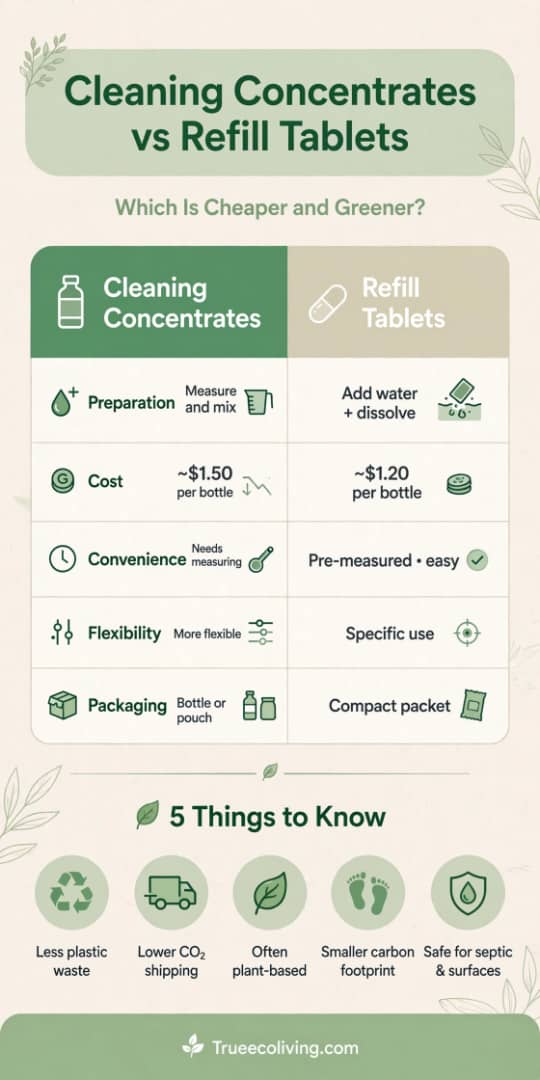
Before looking at the details, here’s a quick comparison of what each format offers. Remember that individual products can differ depending on their formulations, packaging, and instructions.
| What Matters | Cleaning Concentrates | Refill Tablets |
|---|---|---|
| Preparation | Measure and mix with water | Add water and allow the tablet to dissolve |
| Cost | Depends on concentration, dilution, and refill price | Depends on tablet price and the number of bottles produced |
| Convenience | Requires measuring | Usually requires less measuring |
| Flexibility | Some formulas can make different cleaning solutions | Often designed for a specific cleaner or purpose |
| Packaging | May come in bottles, pouches, or other containers | May come in paper, cardboard, or other packaging |
| Storage | Compact compared with ready-to-use cleaners | Usually very compact and lightweight |
| Potential drawback | Measuring errors can waste product | Incorrect water volume or incomplete dissolution can affect use |
| Best suited for | People who value flexibility and potentially broader applications | People who prefer simple, repeatable refills |
The important thing to remember is that these are general differences. Individual products can perform differently depending on their formulations and instructions.
READ ALSO: What Makes a Cleaner Truly Toxic? 7 Red Flags I Never Ignore at Home
1. Which Is Cheaper: Cleaning Concentrates or Refill Tablets?
Let’s start with the question most people want answered: which one saves more money?
My approach is simple. I don’t compare the price of a bottle of concentrate with the price of a packet of tablets. Those figures alone tell us very little.
Instead, I calculate how much it costs to produce the same quantity of correctly diluted cleaning solution.
How to Calculate the Cost of a Cleaning Concentrate
Suppose a concentrate costs $12 and makes six bottles of cleaner when diluted according to the label.
Your cost per bottle is:
$12 ÷ 6 = $2 per bottle.
However, the calculation only works when the manufacturer clearly states how much usable cleaner the concentrate produces.
Some concentrates are designed for multiple applications, so you should calculate the cost of the particular solution you intend to make.
How to Calculate the Cost of Refill Tablets
Now suppose a refill pack costs $10 and contains five tablets, with each tablet making one bottle of cleaner.
Your calculation is:
$10 ÷ 5 = $2 per bottle.
In this hypothetical example, both formats cost the same per bottle before shipping and other expenses.
This is why I encourage people to ignore the idea that one format must always be cheaper.
The winner is the product that delivers the cleaning performance you need at the lowest reasonable cost per use.
When making your own comparison, remember to include delivery charges, taxes, and the initial cost of a reusable bottle if you don’t already own one.
Also consider whether you actually use all the product you buy. A concentrate that sits unused in a cupboard isn’t delivering much value, regardless of how economical its advertised yield looks.
When Concentrates May Offer Better Value
I would consider a concentrate when it offers good value across several cleaning applications.
For example, some formulas can be diluted for different purposes, following the manufacturer’s specific instructions. This can be useful if you want to simplify your collection of cleaning products.
However, versatility is not universal. Some concentrates are designed for a narrow purpose, and others require separate products for different cleaning tasks.
When Refill Tablets May Offer Better Value
Tablets can be a sensible choice if you value convenience and predictable portions.
You don’t need to measure a liquid concentrate each time you prepare a refill. You simply follow the instructions for the particular tablet.
For someone who frequently makes small mistakes while measuring, this convenience may help reduce waste.
My advice? Calculate the actual cost of the finished cleaner, then consider how easily the format fits into your routine.
DISCOVER: Best Non-Toxic Hard Water Stain Removers for Bathrooms: I Compared 15 and These 5 Stand Out
2. Which Is More Convenient for Everyday Cleaning?
Price matters, but convenience often determines whether an eco-friendly habit lasts.
I have found it useful to think about convenience in terms of the steps involved, rather than the claims printed on the packaging.
The Convenience of Cleaning Concentrates
Concentrates require you to measure the correct quantity and mix it with water.
That extra step might seem insignificant, but it can become frustrating when you’re preparing several cleaning bottles or trying to get through household chores quickly.
You must also pay attention to dilution instructions. Using too much product wastes concentrate, while using too little may affect cleaning performance.
On the other hand, I appreciate the flexibility that some concentrates offer. A well-designed system can give you several useful cleaning solutions without requiring you to purchase a separate ready-to-use bottle for every task.
The Convenience of Refill Tablets
Tablets are generally easier to portion because the amount of product is predetermined.
For most household spray refills, the process involves adding the specified amount of water, dropping in the tablet, and waiting for it to dissolve.
There’s less measuring, and individual tablets are easy to store.
However, tablets aren’t entirely effortless. You may need to wait for dissolution before using the cleaner, and you must follow the instructions about water volume.
Some tablets also need to be handled carefully to prevent moisture from affecting the remaining supply.
My verdict on convenience: I would lean towards refill tablets for people who want the simplest repeatable routine. I would lean towards concentrates for those who don’t mind measuring and want more flexibility from a cleaning system.
3. Which Has the Lower Environmental Impact?
This is where things get interesting.
Both concentrates and refill tablets can help reduce the need to transport large quantities of water in ready-to-use cleaning products.
Both can also reduce the number of disposable spray bottles you purchase when you consistently reuse an existing bottle.
But I wouldn’t automatically declare either format the environmental winner.
Packaging Makes a Difference
Concentrates may arrive in plastic bottles, refill pouches, or other containers. Tablets may come in paper packets, cardboard cartons, or packaging made from other materials.
The tablet itself tells you very little about the environmental impact of its entire packaging system.
For example, a compact refill may require less packaging by weight, but you still need to consider the materials used, how far it travels, and whether the packaging can be reused, recycled, or appropriately composted.
I pay attention to what happens after a product arrives in my home, not just how it looks when delivered.
The US Environmental Protection Agency’s guidance on identifying greener cleaning products highlights considerations such as concentrated formulas, lightweight packaging, refillable bottles, and recyclable packaging when evaluating cleaning products.
The practical lesson is that reducing unnecessary packaging is worthwhile, but the entire system matters.
Don’t Ignore Reusable Bottles
If you already own a suitable spray bottle, you may not need to buy another one simply to try refill tablets or concentrates.
That is a simple way to avoid unnecessary purchases.
Before ordering a branded starter kit, I would check whether the refill works with a compatible bottle you already have. Follow the product’s instructions and use a container suitable for the intended solution.
Also, don’t assume packaging marked compostable will break down in your home compost. Check the manufacturer’s disposal instructions and whether the required composting facilities are available where you live.
My recommendation is to choose the refill system you can use consistently while minimising unnecessary purchases and packaging.
4. Which Is Safer and More Effective?
This is the part I wish more cleaning product comparisons would emphasise.
A cleaning format is not a reliable shortcut for judging a formula’s safety or performance.
A tablet isn’t automatically safer because it is solid before use. A concentrate isn’t automatically better because it contains less water than a ready-to-use cleaner.
What matters is the formulation, the intended application, the directions for use, and how the product is handled.
Read the Ingredients, Not Just the Front Label
When evaluating a concentrate or tablet, I look for transparent ingredient information and clear directions.
I also consider fragrance, preservatives, the intended surface, and any precautions listed by the manufacturer.
If a product is marketed as plant-based, I don’t treat that description as proof that every ingredient is harmless. Plant-derived ingredients can have different properties, and the complete formulation matters.
I’ve explored this in more detail in my guide to what plant-based cleaning really means, including ingredients, labels, and limitations. Understanding the difference between a marketing claim and the actual formulation can help you make a more informed choice.
The same care applies when reading a cleaning label. If you aren’t sure what an ingredient does or what a label claim actually guarantees, my article on how to read a cleaning product ingredient list like a pro is a useful next step.
Match the Formula to the Cleaning Task
An all-purpose cleaner isn’t necessarily the right answer for every surface or problem.
For example, a product designed for everyday surface cleaning may not be suitable for removing mineral deposits or treating a particular material.
Likewise, don’t assume a standard cleaning tablet or concentrate disinfects surfaces. If you need disinfection, choose a product specifically labelled for that purpose and follow its directions.
I also recommend following the manufacturer’s dilution instructions rather than adding extra concentrate or water in an attempt to improve performance or stretch the product.
Ultimately, I would choose a well-formulated product with clear ingredient information and appropriate performance for the task, regardless of whether it comes as a liquid concentrate or a tablet.
5. Which Format Should You Choose for Your Home?
After comparing cost, convenience, and packaging, I think the decision becomes easier when you start with your household habits.
Choose cleaning concentrates if:
You are comfortable measuring liquids, want flexibility from a suitable multipurpose formula, and have found a product with good cost per use.
Choose refill tablets if:
You prefer pre-measured portions, want a compact refill that is easy to store, and value a straightforward preparation process.
Consider either format if:
Your main goal is to reduce disposable packaging, provided the product performs well and the refill system genuinely helps you reuse bottles.
I would also consider availability. A refill system that is difficult to obtain locally or expensive to ship may be less practical than a comparable option that is readily available.
You don’t need to replace every cleaning product in your home at once. Start with a frequently used cleaner, calculate the cost, check the ingredients, and see whether the refill routine works for you.
For more options to consider, explore my roundup of top non-toxic and eco-friendly cleaning products. It can help you discover other cleaning options while keeping your household’s needs in mind.
TrueEcoLiving Verdict: Cleaning Concentrates vs Refill Tablets
My verdict is that neither cleaning concentrates nor refill tablets wins in every category.
Concentrates are worth considering when their dilution system offers good value and useful flexibility. Refill tablets stand out when convenience, portability, and predictable portions are your priorities.
From an environmental perspective, both can be sensible alternatives to repeatedly buying ready-to-use cleaning products in disposable bottles. However, the benefits depend on the formula, packaging, transport, and whether you actually reuse the same container.
I would never recommend choosing a product based on the words eco-friendly or non-toxic alone.
Instead, compare the cost per finished bottle, examine the ingredients, consider the packaging, and look at how the product performs for the job you need it to do.
Most importantly, choose a system you can maintain. A realistic, consistent change is more useful than purchasing a collection of supposedly greener products that don’t suit your household.
Conclusion
Cleaning concentrates and refill tablets offer two practical approaches to reducing dependence on ready-to-use cleaning products.
Concentrates can provide flexibility, while tablets make portioning and preparation easier. Both can reduce unnecessary packaging when used with reusable bottles, but neither automatically guarantees lower costs, safer ingredients, or a smaller environmental footprint.
When I evaluate any cleaning product, I return to three questions: What does it cost per use? What is actually in the formula? And what happens to the packaging after I’ve finished with it?
Answer those questions honestly, and you’ll be in a much better position to choose a cleaning system that suits both your budget and your environmental priorities.
Frequently Asked Questions
Not always. Concentrates may offer better value depending on their dilution ratio and the number of usable cleaning solutions they produce. Tablets can be competitively priced because each refill provides a predetermined portion. Compare the cost per bottle at the correct dilution, including shipping and taxes.
They can help reduce plastic waste when their packaging uses less plastic and you reuse an existing bottle. However, the environmental benefit depends on the packaging materials, product delivery, and disposal options. Check the complete packaging rather than assuming every tablet is plastic-free.
Neither format is automatically safer. Safety depends on the ingredients, formulation, intended use, and handling instructions. Read the product label, follow the manufacturer’s directions, and select a formula appropriate for your household’s cleaning needs.
Often, yes, provided the bottle is suitable for the intended cleaner and each product’s instructions allow it. Empty and clean the bottle appropriately before switching products, and never mix different cleaning formulations together. Follow the manufacturer’s dilution instructions and label your bottles clearly so everyone knows what is inside.