
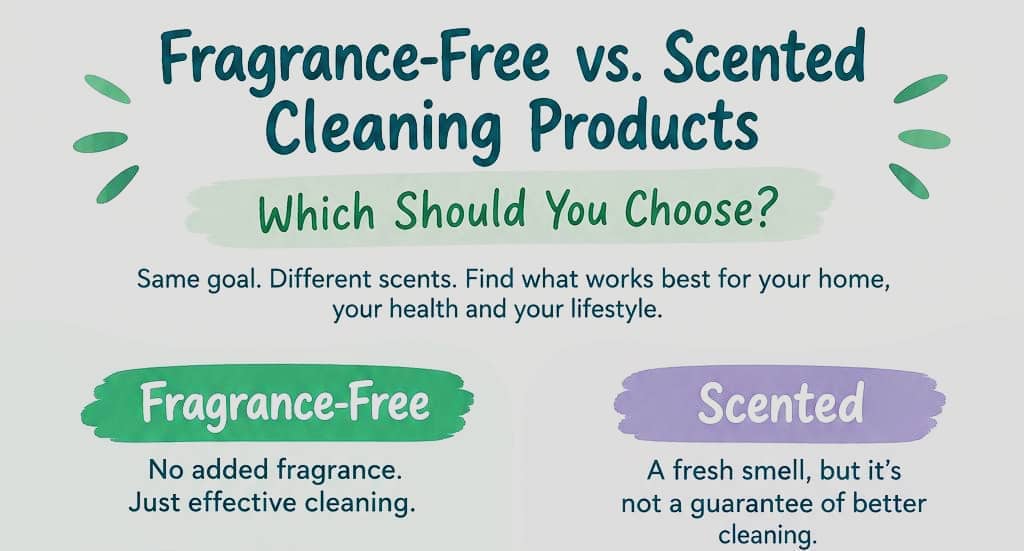
Have you ever finished cleaning your home and felt that something was missing because the room did not smell like lemon, lavender, or fresh flowers? Many people associate a pleasant fragrance with cleanliness.
However, a home does not need to smell like perfume to be clean, and a strong fragrance does not prove that a cleaning product works better.
As someone who takes a thoughtful approach to non-toxic cleaning and eco-friendly living, I believe choosing household cleaners involves more than picking a scent you enjoy.
I consider the ingredients, cleaning performance, household needs, and potential environmental impact before deciding which products make sense for everyday use.
So, should you choose fragrance-free or scented cleaning products? Let’s look at the differences, clear up common misconceptions, and help you make a more informed choice for your home.
Fragrance-Free vs. Scented Cleaning Products: 5 Things to Know
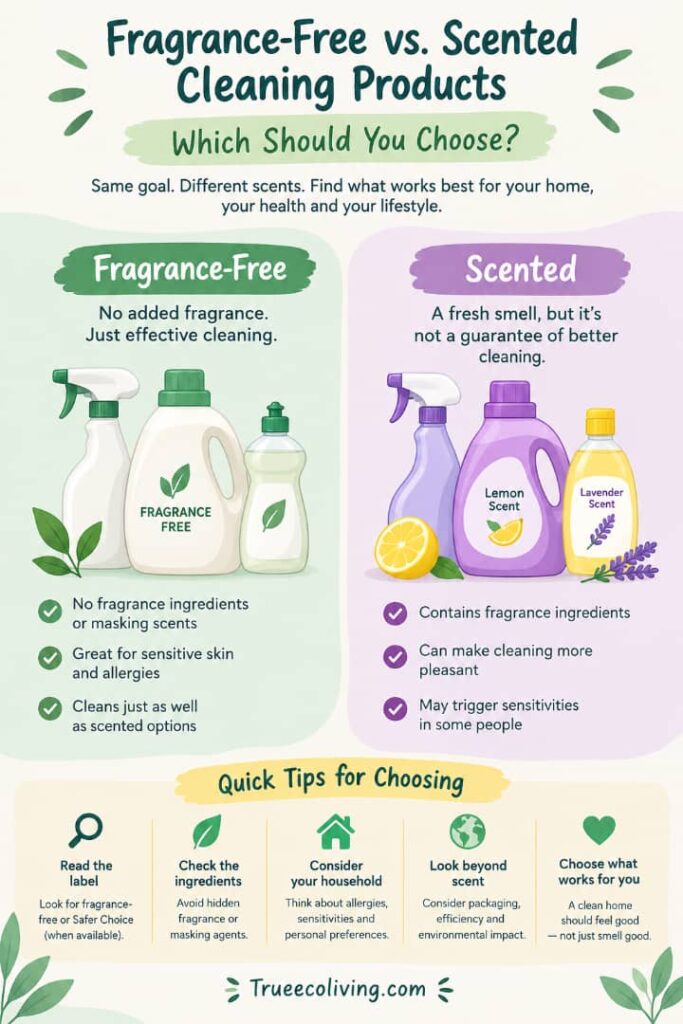
- Fragrance-free cleaners are designed without added fragrance materials or scents used to mask other odors.
- Scented cleaners contain fragrance ingredients that give them a particular smell, but this does not necessarily improve cleaning performance.
- Unscented does not always mean fragrance-free. Some products use ingredients to mask the smell of other ingredients.
- Natural fragrances can still cause sensitivities. Essential oils and plant-derived fragrances are not automatically suitable for everyone.
- The best choice depends on your needs. Consider ingredients, cleaning effectiveness, household sensitivities, and packaging instead of judging a product by its scent alone.
What Is the Difference Between Fragrance-Free and Scented Cleaning Products?
What Are Fragrance-Free Cleaning Products?
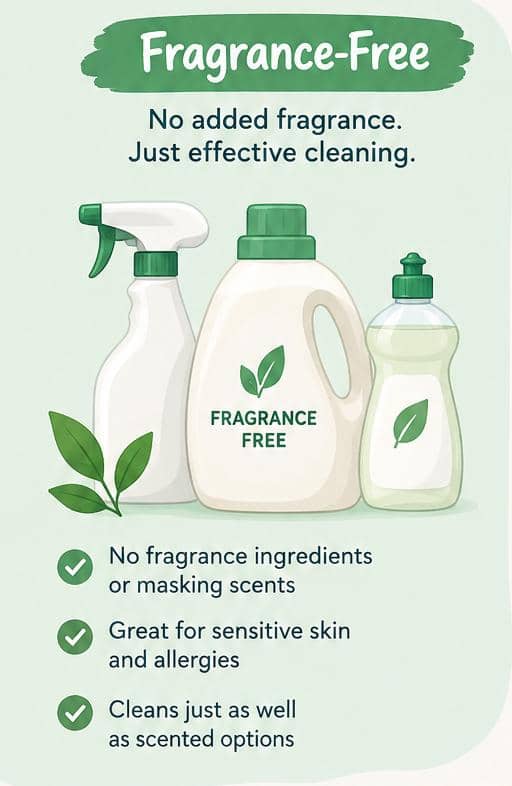
Fragrance-free cleaning products are formulated without fragrance materials or masking scents. You can find them in laundry detergents, dishwashing liquids, bathroom cleaners, and multipurpose cleaning products.
I consider fragrance-free products a practical option for households that prefer to avoid added scents.
They can be especially worth considering when someone in the home experiences discomfort around fragrances or simply dislikes lingering smells.
However, fragrance-free does not mean odor-free or chemical-free. A product may still have a noticeable smell from its cleaning agents or other ingredients.
It can also contain substances that irritate the skin, eyes, or respiratory system. The complete formulation matters more than one label claim.
DISCOVER: 15 Best Non Toxic Cleaning Products for a Safer and Eco Friendly Home (2026)
What Are Scented Cleaning Products?
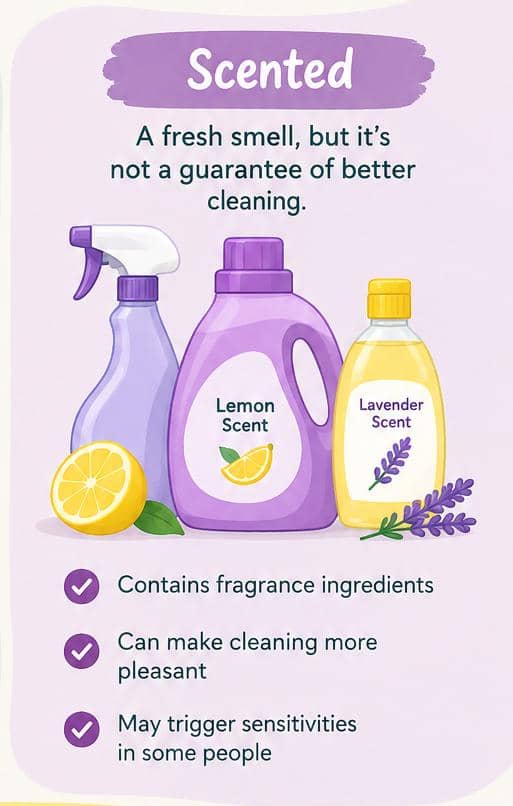
Scented cleaning products contain fragrance ingredients intended to give them a particular smell. Common examples include lemon-scented floor cleaners, lavender laundry detergents, and floral bathroom sprays.
Manufacturers may use synthetic fragrances, plant-derived ingredients, essential oils, or combinations of these materials. I understand why these products appeal to people.
A familiar scent can make cleaning feel more enjoyable and leave a room smelling the way they prefer.
Still, I would not judge a cleaner by its fragrance. A scented product can clean poorly, while a fragrance-free alternative can remove dirt and grease effectively.
Performance depends on the formulation, the surface, the type of soil, and whether the product is used correctly.
Fragrance-Free vs. Scented: Which Is Better for Your Health?
Fragrance affects people differently. Some people tolerate scented cleaners without noticeable problems, while others experience headaches, eye or throat irritation, coughing, or other uncomfortable symptoms around particular fragrances.
If someone in my household were sensitive to fragrances, I would start by considering fragrance-free alternatives.
Reducing fragrance exposure may help some people feel more comfortable, although it cannot guarantee that symptoms will disappear. Other ingredients and environmental factors may also contribute.
What about products labelled natural? I would be just as thoughtful about these. Essential oils and other plant-derived fragrance ingredients can also trigger sensitivities in some individuals.
Natural does not automatically mean harmless, just as synthetic does not automatically mean dangerous.
My approach is to consider the complete formulation, how often the product will be used, and whether anyone in the household has known sensitivities.
I also follow label directions and ventilate rooms appropriately when cleaning.
Fragrance-Free vs. Unscented: What Do the Labels Mean?
This is one label distinction I encourage shoppers to understand. Fragrance-free and unscented are not necessarily interchangeable terms.
An unscented product may contain ingredients that mask or neutralize the smell of other ingredients without giving the finished product an obvious fragrance.
Fragrance-free products, by contrast, are intended to be formulated without fragrance materials or masking scents.
If your goal is to avoid added fragrance, I would look beyond the word unscented and examine the product information.
Where available, an independent standard can provide additional guidance. The U.S. Environmental Protection Agency’s Safer Choice Standard includes criteria for qualifying fragrance-free products.
| Label or claim | What it means |
|---|---|
| Fragrance-free | Intended to contain no fragrance materials or masking scents. |
| Unscented | May have little or no noticeable smell but could contain masking ingredients. |
| Naturally scented | Uses natural fragrance sources, which can still cause sensitivities. |
| Fresh scent or clean scent | Describes the fragrance experience, not cleaning effectiveness. |
| Safer Choice with a fragrance-free designation | Provides additional assurance through the EPA’s criteria for qualifying products. |
Do Fragrance-Free Cleaners Work as Well as Scented Ones?
Yes. Fragrance-free products can clean just as effectively as scented alternatives when their formulations are designed for the same task and used as directed.
A fragrance-free laundry detergent can remove everyday soil from clothing. A suitable fragrance-free dishwashing liquid can remove food residue and grease, while a fragrance-free multipurpose cleaner can handle appropriate household surfaces.
I prefer to focus on what the product is designed to do rather than whether it smells like citrus or flowers. The right cleaning ingredients, product concentration, surface compatibility, and application method are far more important than fragrance.
There is one important distinction: cleaning and disinfecting are not the same thing. A product that removes dirt should not automatically be assumed to kill germs.
When disinfection is necessary, choose a product intended for that purpose and follow its instructions.
Which Option Is Better for an Eco-Friendly Home?
Fragrance-free cleaners can be a useful part of a more conscious cleaning routine, particularly when reducing added fragrance is a priority.
However, I would not automatically label every fragrance-free product eco-friendly. Environmental impact involves much more than scent.
When comparing household cleaners, I pay attention to four things:
- Ingredients: Look for meaningful ingredient information instead of relying only on terms such as natural, green, or clean.
- Packaging: Concentrated products and refill options may reduce packaging waste, depending on how they are packaged and used.
- Efficiency: Choose products suited to the job and follow the recommended dosage. Using more cleaner does not automatically produce better results.
- Indoor air and household needs: Consider fragrance exposure, ventilation, personal sensitivities, and how the product will be applied.
I also believe buying fewer products that genuinely meet your needs is often more practical than collecting separate cleaners for every room and fragrance.
A thoughtful routine can support both everyday cleaning and more responsible purchasing decisions.
How to Choose the Right Cleaning Product for Your Home
If you prefer to avoid added fragrance, dislike lingering scents, or have household members who experience fragrance sensitivity, fragrance-free products are a sensible place to start.
If you enjoy scented products and tolerate them well, a scented cleaner may also be appropriate. I would still review the product information and make sure it is suitable for the surface and task.
Whichever option you choose, read the label, use the recommended amount, and follow the safety instructions. Never mix cleaning products, especially bleach with ammonia or acidic cleaners.
I would also avoid using a strong fragrance to cover up a persistent household odor. Identifying and cleaning the source is generally a better approach than masking the smell.
LEARN MORE: How to Read a Cleaning Product Ingredient List Like a Pro (7 Things Most People Miss!)
Conclusion: Fragrance-Free or Scented?
When comparing fragrance-free vs. scented cleaning products, I would not make the decision based on fragrance alone.
Fragrance-free products can be a practical choice for people who want to avoid added scents, particularly in households where fragrance sensitivity is a concern.
Scented products may suit people who enjoy fragrance and tolerate the products they use.
My advice is to understand the label, consider the complete formulation, and choose a cleaner that suits your household and the job at hand.
A clean home does not need an overpowering scent to feel fresh. What matters is effective cleaning, informed choices, and a comfortable environment for the people who live there.
Frequently Asked Questions
Neither option is automatically better for everyone. Fragrance-free products may suit people who prefer to avoid added fragrances or experience sensitivity to them. Scented products may be suitable for people who tolerate them well. Ingredients, cleaning performance, and correct use matter for both.
No. All cleaning products contain chemical substances, including ingredients derived from natural sources. Fragrance-free means the product is formulated without fragrance materials or masking scents. It does not mean the product contains no chemicals or cannot cause irritation.
Not necessarily. Natural and synthetic fragrance ingredients can both cause sensitivities in some people. The source of a fragrance does not establish the safety of the complete product, so consider the ingredients and your household’s needs rather than relying on the word natural.
Look for a fragrance-free claim and review the available ingredient information. Unscented products may contain masking ingredients. Where available, an independent designation, such as the EPA Safer Choice fragrance-free designation, can provide additional assurance.