
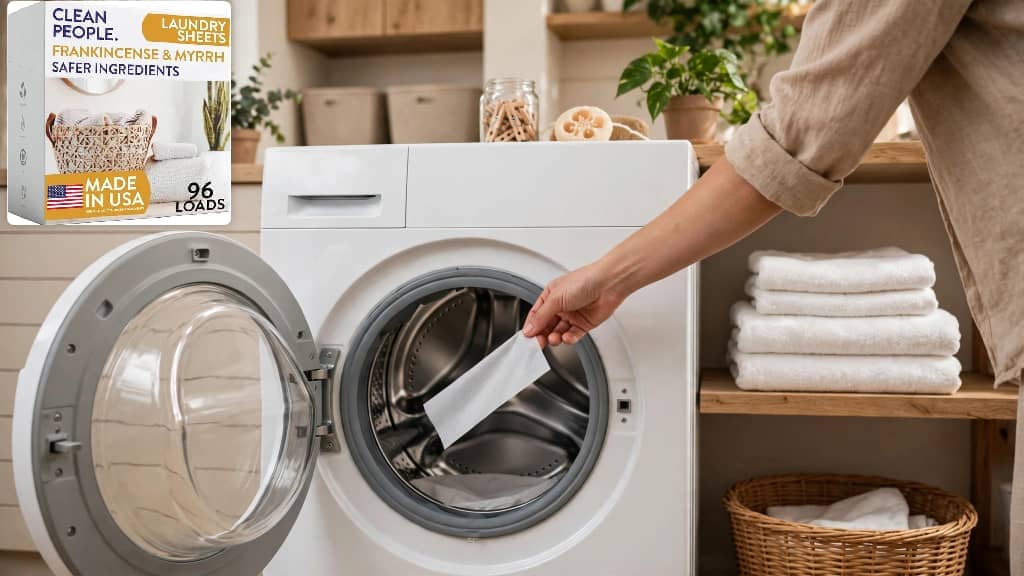
Clean People Laundry Sheets are marketed as a convenient, eco-friendly alternative to traditional liquid laundry detergents. Instead of carrying a heavy plastic detergent bottle, you get lightweight detergent sheets that you simply place inside your washing machine.
First seeing it, I can understand the attraction. Less packaging, no measuring, no messy liquid spills and a compact box that takes up very little storage space. But as someone who looks closely at ingredients and practical eco-friendly cleaning choices, I believe there’s more to a laundry detergent than attractive packaging and promises of a cleaner lifestyle.
For this review, I examined Clean People’s published ingredients, dosage instructions, pricing and available independent product reviews, including a month-long product trial and a separate stain comparison.
Affiliate Disclosure: This post contain affiliate links. If you purchase through these links, TrueEcoLiving may earn a small commission at no additional cost to you. I only aim to recommend products that I believe may offer value to my readers. Your support helps keep TrueEcoLiving running. Thank you!
What Are Clean People Laundry Sheets?
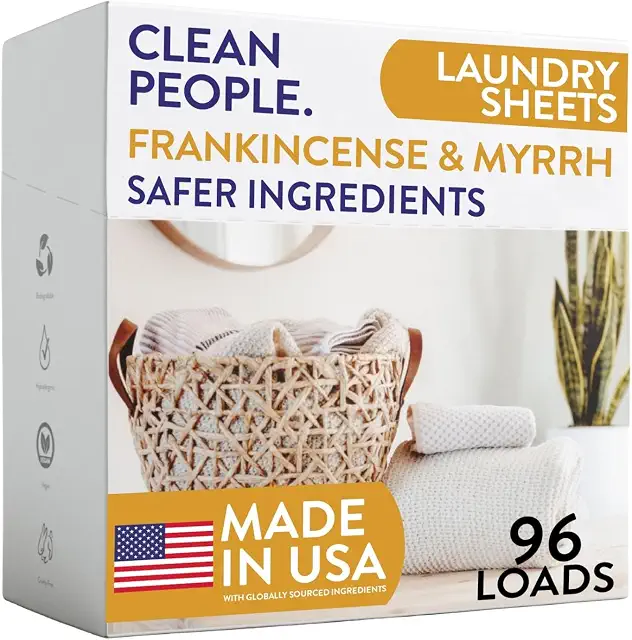
Clean People Laundry Sheets are concentrated detergent strips designed to dissolve in water during a washing cycle. They are packaged in lightweight cardboard boxes rather than conventional bulky plastic detergent containers.
The brand offers different varieties, including Fresh & Clean, Fragrance Free, Lavender and Baby. The sheets are designed for regular top-loading machines, front-loading machines and high-efficiency (HE) washers.
One interesting feature is their perforated design. You can separate a sheet into smaller portions depending on how much laundry you are washing. This gives you some flexibility instead of using an identical amount of detergent for every wash.
Clean People Laundry Sheets Ingredients: What’s Actually Inside?
This is where I become particularly interested. Clean People promotes its detergent as a cleaner alternative to conventional laundry products, but I prefer looking beyond marketing language and understanding what actually makes the product work.
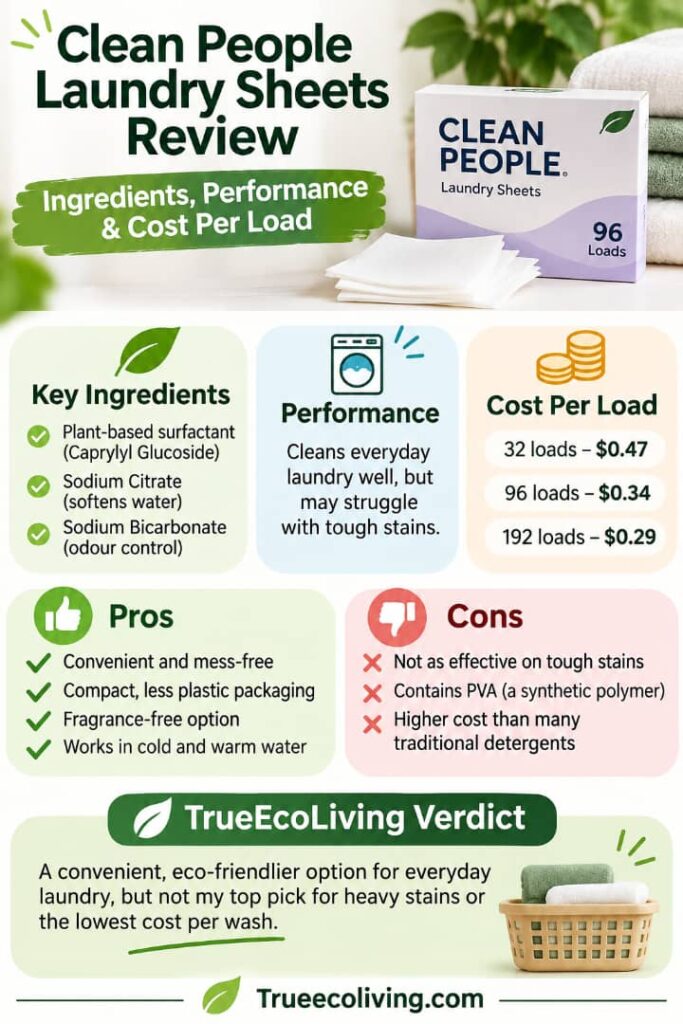
According to the brand’s published ingredient information, the laundry sheets contain:
- Polyvinyl Alcohol (PVA): A water-soluble synthetic polymer used to form the detergent sheet. It helps hold the concentrated detergent together until it comes into contact with water.
- Starch: Used to provide structure to the sheet.
- Sodium C14-16 Olefin Sulfonate: A synthetic surfactant that helps loosen dirt and oils from fabric so they can be rinsed away.
- Glycerin: A multifunctional ingredient used in the formulation.
- Caprylyl Glucoside: A surfactant commonly derived from plant-based feedstocks that supports cleaning.
- Caprylic/Capric Triglyceride: An ingredient used as a processing aid in the formulation.
- Sodium Citrate Dihydrate: Helps manage water hardness by binding some mineral ions.
- Sodium Bicarbonate: Helps adjust pH and control unwanted odours.
- Fragrance: Included in scented varieties but not the fragrance-free formula.
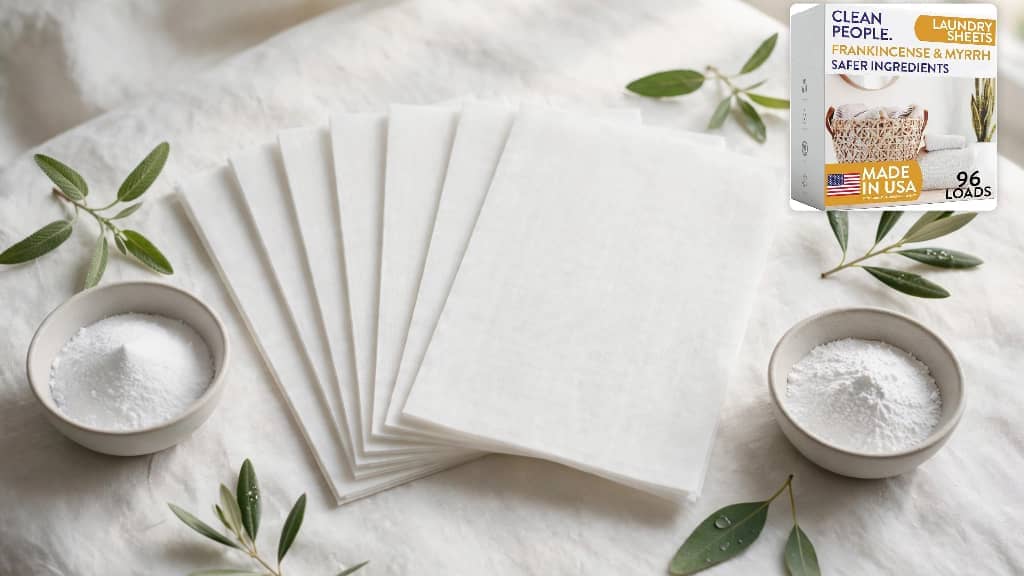
I particularly like seeing sodium citrate and caprylyl glucoside in the formulation. These ingredients have useful roles in cleaning, and I appreciate that the formula does not rely on simply covering unpleasant laundry smells with heavy perfume.
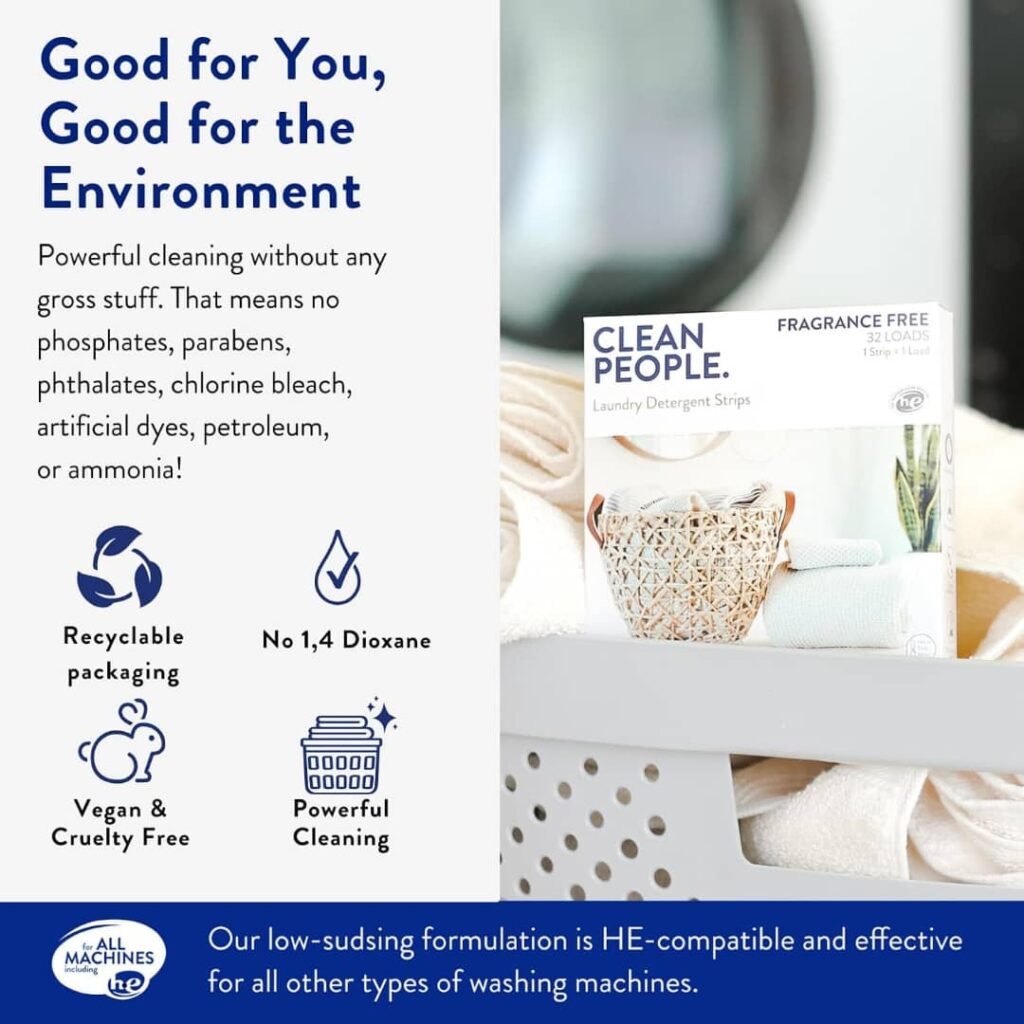
Clean People also states that its laundry sheets are free from phosphates, parabens, synthetic dyes, optical brighteners, chlorine bleach, ammonia, formaldehyde and certain preservatives, including MIT and BIT.
However, I wouldn’t describe the formula as entirely natural or chemical-free. Sodium C14-16 olefin sulfonate is synthetic, and PVA is a synthetic polymer. That doesn’t automatically make the product unsafe, but it is important to understand what you are buying.
Another detail worth mentioning is that the current public ingredient list does not identify a specific enzyme blend for tackling protein, starch and oily stains.
I would therefore avoid assuming these sheets have the same heavy-duty stain-removing abilities as an enzyme-powered detergent.
Do Clean People Laundry Sheets Actually Clean Clothes?
This is probably the most important question. An environmentally conscious detergent is only a practical choice when it can also clean clothes properly.
Looking across published reviews, I found two noticeably different experiences.
The positive experience
A product tester featured in an October 2025 review by Illuminate Labs used Clean People Laundry Sheets for a month. The tester reported that the sheets were convenient, left clothes feeling soft and cleaned everyday laundry without leaving visible residue.
The fragrance-free formula also received positive feedback. The tester appreciated that clothes came out smelling fresh without needing a strong added fragrance.
The less impressive experience
A separate comparison published by The Laundry Guru evaluated Clean People alongside Earth Breeze. Both products dissolved during the reviewer’s washing tests, but Clean People did not perform as well when the reviewer tested tomato sauce, olive oil and wine stains on napkins.
The reviewer gave Clean People 2.5 out of 5 for cleaning power in that comparison. This suggests that although the sheets may be suitable for ordinary laundry, I would be cautious about relying on them for heavily stained clothing.
There is also a broader consideration. Consumer Reports’ laboratory testing of six laundry-sheet brands found that the category generally struggled with stain removal compared with traditional liquid detergents and pods.
Clean People was not one of the six brands in that particular test, so its results should not be mistaken for a direct Clean People rating.
My interpretation is simple: these sheets may be perfectly adequate for everyday washing, but I wouldn’t choose them as my only solution for muddy clothes, greasy kitchen towels, heavily soiled workwear or stubborn food stains. Pretreating difficult stains is still a sensible part of laundry care.
Read Also: 5 Best Non-Toxic Laundry Stain Removers for Clothes That Actually Work (Safer Picks Worth Trying)
Do the Sheets Dissolve Properly?
Clean People says its sheets work in both cold and warm washing conditions. The independent comparison I reviewed also reported successful dissolution in different water temperatures.
However, customer feedback is not entirely consistent. Some shoppers have reported finding undissolved material or residue after washing, particularly when the sheets have not dissolved properly.
To get the best chance of dissolution, I would follow the manufacturer’s instructions: place the required strip at the bottom of the washing-machine drum before adding clothes. I would also avoid overloading the machine.
One additional point: don’t judge the detergent by how much foam it produces. Clean People explains that its formula is designed to produce fewer suds, and low-sudsing detergent can still clean effectively in modern HE machines.
Clean People Laundry Sheets Cost Per Load
Now, let’s talk about something I always consider when evaluating eco-friendly cleaning products: the actual cost of using them.
Clean People’s store currently lists the following regular prices for its laundry sheets. Prices are in US dollars and may change with promotions or retailer discounts.
| Pack Size | Listed Price | Cost Per Load |
|---|---|---|
| 32 loads | $15.00 | $0.47 |
| 96 loads | $33.00 | $0.34 |
| 192 loads | $55.00 | $0.29 |
These calculations use the brand’s recommended standard dose of one perforated strip, approximately half a sheet, for a medium load.
Something I want you to pay attention to is load size. Clean People recommends using a smaller portion for small loads and a full sheet for larger loads. Consequently, the amount you actually spend per washing cycle can increase when you regularly wash larger loads.
For me, the 192-load option offers the best value among these three packages. However, at approximately 29 cents per standard load, it is still a premium-priced laundry option compared with many conventional powders.
Are Clean People Laundry Sheets Environmentally Friendly?
This is where I think Clean People deserves some credit, although I wouldn’t call the product a completely impact-free solution.
Its biggest practical advantage is packaging. Replacing large liquid detergent bottles with lightweight cardboard packaging can reduce reliance on bulky plastic containers and the weight of products being transported.
However, there is one ingredient I don’t overlook: PVA. It is a water-soluble polymer that helps hold the detergent sheet together. Dissolving in water and biodegrading under wastewater treatment conditions are related but different processes.
Research published in 2024 found extensive biodegradation of a particular detergent-grade PVA during simulated wastewater treatment. That’s encouraging, but it was not a direct environmental assessment of Clean People’s exact sheet formulation or every wastewater system.
So, my position is balanced. I appreciate the reduction in bulky packaging, but I wouldn’t automatically describe the product as zero-waste or completely plastic-free simply because it comes in a cardboard box.
READ MORE: 8 Ways to Build a Low-Waste Laundry Routine Without Buying More Products
Who Should Buy Clean People Laundry Sheets?
Based on the available product information and reviews, I think Clean People may suit people who:
- Prefer lightweight, compact laundry products instead of bulky detergent bottles.
- Want a convenient detergent for ordinary, lightly soiled laundry.
- Prefer a fragrance-free option and want to avoid certain common detergent additives.
- Travel regularly or have limited storage space.
- Are willing to pay a little more for convenience and reduced packaging.
I would be less enthusiastic about recommending it to households that regularly deal with heavy stains, very dirty clothing or tight laundry budgets. In those situations, a well-formulated concentrated liquid or powder detergent may offer better cleaning performance and value.
TrueEcoLiving Verdict
After comparing the ingredients, product claims, pricing and available independent reviews, I see Clean People Laundry Sheets as a convenient alternative rather than a perfect replacement for every traditional laundry detergent.
I like the compact cardboard packaging, the fragrance-free option and the relatively straightforward ingredient list. I also appreciate that the brand provides different sheet portions for different laundry loads.
What holds me back is the inconsistent evidence around cleaning performance, particularly with stubborn stains, alongside the relatively high cost per standard wash. I also think consumers deserve a realistic explanation of PVA rather than assuming that dissolvable automatically means environmentally harmless.
My recommendation: Clean People is worth considering if convenience, lightweight packaging and everyday washing are your priorities. However, I wouldn’t make it my first choice if heavy-duty stain removal or the lowest possible cost per wash matters most.
For me, genuinely sustainable cleaning means finding the balance between effective cleaning, sensible ingredients, reasonable pricing and reduced environmental impact. Clean People gets some of those things right, but there is still room for improvement.
Further reading: For a closer look at the environmental behaviour of detergent-grade PVA, see this 2024 peer-reviewed study on polyvinyl alcohol and wastewater treatment.
Frequently Asked Questions
Yes. The formula contains polyvinyl alcohol (PVA), a water-soluble synthetic polymer used to form the detergent sheet. Although it dissolves in water, this does not automatically mean it has zero environmental impact.
Clean People offers a fragrance-free formula and describes its detergent as hypoallergenic. This may be a useful option for people who prefer to avoid added fragrance, although individual skin sensitivities vary. Always check the current ingredient label.
At the regular prices reviewed, the 32-load package costs approximately 47 cents per load, the 96-load package approximately 34 cents, and the 192-load package approximately 29 cents. Larger loads may require more detergent.
They may handle ordinary everyday laundry, but published comparisons suggest their stain-removal performance can be limited. For stubborn grease, food stains and heavily soiled clothing, pretreating stains or using a stronger detergent may be necessary.
About the Author
Agboola Elizabeth writes about practical non-toxic cleaning, sustainable household choices and eco-friendly living at TrueEcoLiving. Her goal is to help readers make informed decisions about everyday products, understand ingredients and discover more thoughtful ways to care for their homes and the environment.