12 Verified Tools to Plan a Low Impact Trip Without Greenwashing
You can start planning a sustainable trip with the best intentions and still end up buried under too many tabs, too many claims, and too many green badges that do not really mean much.
One hotel says eco friendly. Another booking site says carbon neutral. A flight app promises offsets. Then you are left wondering what is actually real and what is just marketing with a leaf on it.
That is the problem this guide is meant to solve. A truly low impact trip is not built on vague promises. It is built with tools that help you measure emissions, choose better routes, book stays that are actually verified, and cut waste while you travel.
Once you use the right tools in the right order, sustainable travel stops feeling confusing and starts feeling practical.
In this post, I will walk you through 12 verified tools that can help you plan with more confidence and less guesswork. You do not need to use every single one at once. Start with the basics, build your routine, and let the system do the heavy lifting for you.
In a Nutshell
- Measure your trip first so you know your starting point.
- Choose lower impact routes before booking anything else.
- Use verified booking platforms instead of vague eco labels.
- Reduce waste while you travel with refill and rescue tools.
| Trip Stage | Tool Type | Main Benefit |
|---|---|---|
| Measure | Carbon calculators | Shows your footprint clearly |
| Plan | Route and itinerary tools | Helps lower emissions before booking |
| Book | Verified stay platforms | Reduces greenwashing risk |
| Travel | Refill and food rescue apps | Cuts waste on the ground |
If you have ever wondered whether sustainable travel is even possible without doing a full research project, the answer is yes. The trick is to stop relying on one shiny label and start using tools that show concrete details.
A clear carbon calculator tells you what you are working with. A verified booking platform tells you what a property actually does. A refill app and a food rescue app help you keep daily waste down once the trip begins.
That kind of structure matters. It saves time, lowers stress, and helps you travel in a way that feels thoughtful instead of performative. In my view, that is what low impact travel should be about. Not perfection. Just better choices, made consistently.
READ ALSO: 5 Zero-Waste Beach Day Essentials (No Mess, All Fun)
Why So Many Eco Travel Tools Fall Short
Not every tool that says sustainable actually helps you travel better. Some rely on vague self reported claims. Others lean too hard on offsets without showing you what they are offsetting. Some AI planners generate nice sounding recommendations but never explain where the data comes from.
That is where the problem starts. If a tool cannot show its method, it is hard to trust its result. You may feel better after clicking a green button, but your trip may not be much different in reality.
Real sustainability needs more than good branding. It needs transparency, measurable impact, and practical action.
The tools below were chosen for one reason. They help you make decisions you can actually stand behind.
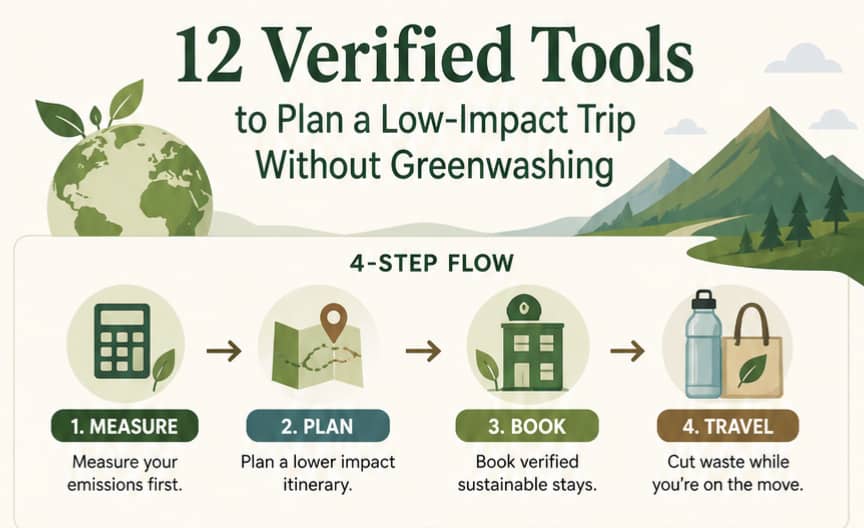
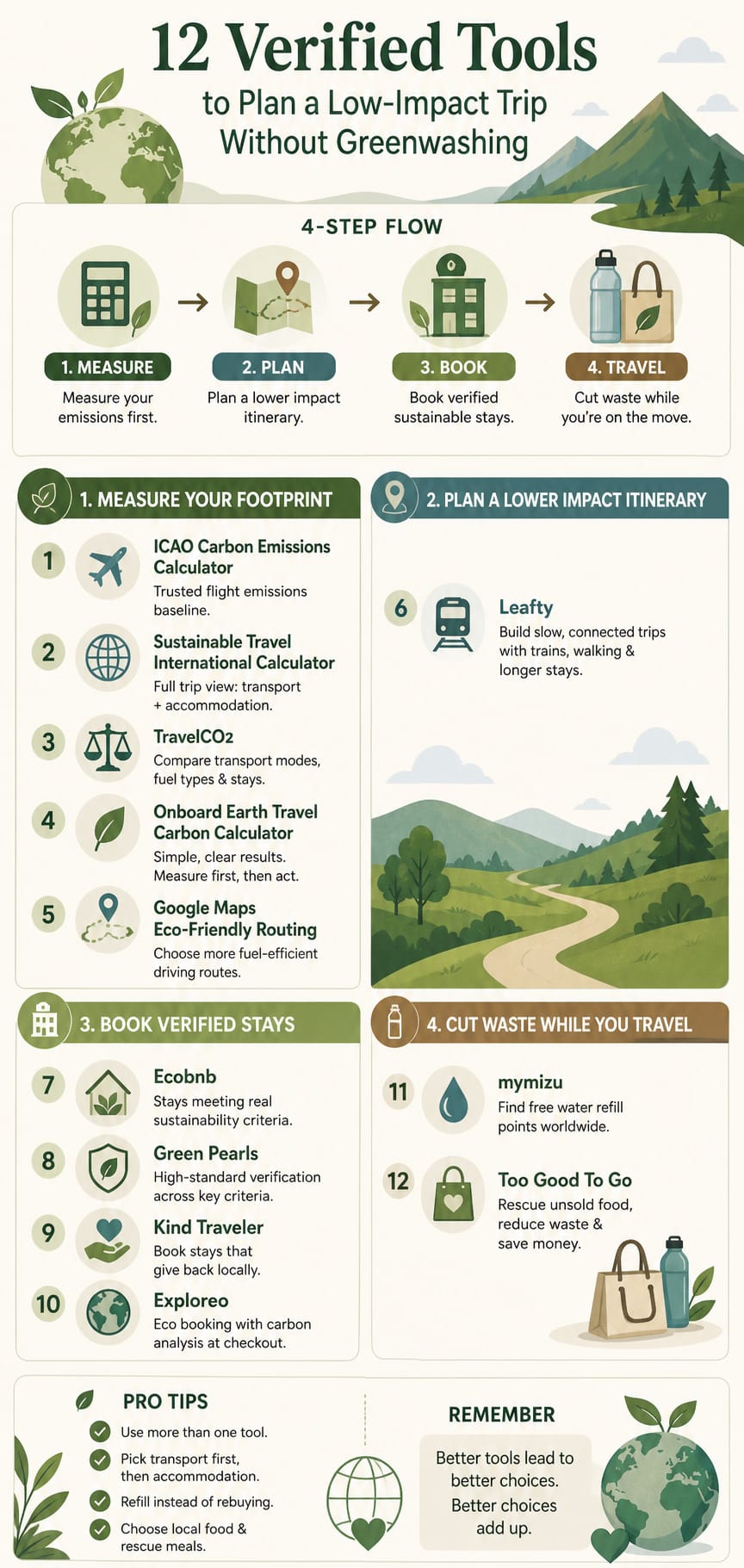
A Simple 4 Step Flow for Low Impact Travel
Think of this as a simple travel planning sequence.
- Step 1: Measure your emissions first.
- Step 2: Plan a lower impact itinerary.
- Step 3: Book verified sustainable stays.
- Step 4: Cut waste while you are on the move.
That sequence keeps the process simple. Once you know your footprint, you can compare options more clearly.
Once you know your route, you can avoid high emission habits without overthinking everything. And once you are on the road, the right reuse and refill tools keep the waste down naturally.
Section 1: Measure Your Trip’s Carbon Footprint
You cannot improve what you never measure. That is why a good carbon calculator is the best place to begin. These tools help turn an abstract idea into something you can actually compare before you book.
1. ICAO Carbon Emissions Calculator
This is one of the most trusted tools for flight emissions. You enter your departure and arrival airports, travel class, and passenger count, and it gives you a clear estimate for the flight. It is especially useful when you want a reliable baseline before booking.
What makes it useful is its simplicity. It strips away the noise and gives you a number you can compare across flights. If you are deciding between a direct route and a multi stop route, the difference becomes much easier to see.
EXPLORE: 7 Zero-Waste Airport Hacks Nobody Tells You About (Travel Smarter, Waste Less)
2. Sustainable Travel International Carbon Footprint Calculator
This calculator goes beyond flights and gives you a fuller view of the whole trip. It covers transport and accommodation, which is helpful if your travel includes trains, cars, and hotel stays. That makes it a good option when you want a broader picture instead of only one piece of the puzzle.
It is especially useful for road trips and multi city travel. Instead of guessing which part of your itinerary matters most, you can see the total and use that as a reference point for better choices.
3. TravelCO2
TravelCO2 is helpful when you want to compare travel choices side by side. You can test different transport modes, fuel types, and lodging options, which makes it feel more like a decision tool than a simple calculator.
That comparison style is useful when you are trying to decide whether to fly, drive, or take the train. It helps turn a vague sustainability question into a practical planning choice.
4. Onboard Earth Travel Carbon Calculator
This tool keeps the process simple and easy to understand. You enter one or more journeys and get a quick result. It is also useful because it separates measurement from any optional restoration support, which is a healthier way to think about impact than using offsets as a shortcut.
That distinction matters. First measure. Then reduce where you can. Then decide whether any additional action is needed. That order is much more honest than skipping straight to a feel good button.
9 Eco Friendly Packing Tips That Save Space, Cut Waste, and Make Travel Easier
5. Google Maps Eco Friendly Routing
You may already use Google Maps without realizing it can help reduce fuel use. For driving directions, it can suggest a more fuel efficient route instead of only the fastest one. It factors in traffic patterns, road conditions, and driving behavior to estimate a route that may use less fuel.
This is one of the easiest tools to use because it does not require extra setup. You just check the route options and choose the one that makes more sense for your trip. Small changes like this can add up over long drives.
Section 2: Plan a Lower Impact Itinerary
Once you know your footprint, the next step is shaping the trip itself. That means choosing destinations and transport styles that naturally create less impact instead of trying to patch things later.
6. Leafty

Leafty is useful if you like the idea of slow travel. It helps you build connected trips with a stronger focus on ground level exploration, walking, trains, and longer stays in each place. That often leads to a better travel experience too, not just a lower footprint.
What I like about this kind of tool is that it encourages depth instead of rushing. You spend more time experiencing a place and less time bouncing between airports. That usually feels more memorable and less exhausting.
Section 3: Book Stays That Are Actually Verified
Hotel greenwashing is one of the easiest places to get misled. That is why the next set of tools matters so much. These platforms aim for stronger verification or more direct community benefit.
7. Ecobnb

Ecobnb focuses on accommodations that meet a set of sustainability criteria. The platform often highlights practical details such as renewable energy, organic food, and lower impact arrival options. That makes it easier to see whether a stay is genuinely aligned with your values.
It is especially useful if you want places that feel personal and rooted in their local environment rather than generic. You are more likely to find stays that actually care about how they operate.
DISCOVER: Best Eco Friendly Travel Essentials for 2026: 12 Packing Musts
8. Green Pearls

Green Pearls is built around stronger verification. Properties need to meet a high share of sustainability criteria before they are listed. That can include water saving, waste reduction, local culture support, and other concrete practices.
That kind of vetting gives you more confidence. Instead of trusting a marketing badge, you are looking at a platform that has done part of the checking for you.
9. Kind Traveler

Kind Traveler stands out because it connects travel with local giving. Through its give back model, part of the stay supports a community cause. That means your booking can do something positive beyond simply reducing harm.
This approach is useful because it makes travel feel more connected to the place you are visiting. You are not only staying somewhere. You are also contributing to something local and meaningful.
10. Exploreo
Exploreo combines eco travel booking with carbon analysis so you can see more of the impact at checkout. That transparency is valuable because it keeps the footprint visible instead of hiding it behind vague promises.
It also helps show where any supporting action is going. That kind of clarity is exactly what a low impact planning tool should provide. Show the number. Show the options. Let the traveler make a real decision.
Section 4: Cut Waste While You Travel
Planning is only part of the story. Once the trip begins, daily habits matter too. The two biggest ones are avoiding single use plastic and keeping food waste down.
11. mymizu
mymizu helps you find free refill points for water, which is a simple way to reduce bottled water waste. The app shows locations where you can refill your bottle, and users can also add new points to the map. That makes it both practical and community driven.
This is one of the easiest habits to keep on any trip. Carry a bottle, refill it often, and skip buying more plastic than you need. The savings add up quickly.
12. Too Good To Go
Too Good To Go helps you rescue unsold food that would otherwise be thrown away. You can book a surprise bag from a bakery, restaurant, or store and pick it up at a set time. It is budget friendly, fun to use, and a direct way to reduce food waste while traveling.
For travel days, that is very useful. You can eat well, save money, and keep perfectly good food out of the bin. It is one of the rare tools that helps your trip and the planet at the same time.
Why These 12 Made the Cut
Plenty of travel tools talk a good game, but not all of them hold up under scrutiny. I left out anything that depended too heavily on vague carbon offsets, unclear AI recommendations, or green labels that were not backed by clear standards. I also excluded anything that sounded useful but did not offer enough transparency to trust.
The tools in this list were chosen because they help you do something concrete. They measure, compare, verify, refill, or rescue. That is the difference between marketing and usefulness.
Practical Example: A Low Impact Trip in Action
Let us say you are planning a five day trip from London to the South of France. You want a beautiful trip, but you also want to be thoughtful about your footprint.
First, you check the flight on ICAO and compare it with a train based option using Sustainable Travel International. Then you use Leafty to build a slower itinerary that includes a few connected stops instead of a rushed flight hop.
For accommodation, you compare Ecobnb, Green Pearls, and Kind Traveler so you can choose a stay with actual sustainability practices, not just a nice badge.
Once you are there, you use mymizu to refill your bottle and Too Good To Go to pick up a meal that would have gone to waste. The result is a trip that feels less rushed, less wasteful, and more rooted in the places you visit.
That is the whole point. Better tools lead to better choices, and better choices add up.
READ ALSO: Tiny Thermostat Habits Saved Our Household Over $200 in Six Months
Pro Tips for Traveling Sustainably
A few simple habits make these tools even more effective.
- Use more than one tool, because no single app gives the full picture.
- Pick transport first, then accommodation, because travel mode often has the bigger impact.
- Refill instead of rebuying whenever you can.
- Choose local food and rescue meals when possible.
These are small habits, but they are the kind that change how a whole trip feels.
Common Mistakes to Avoid
One common mistake is trusting a green label without checking what it actually means. Another is using offsets as a substitute for reducing emissions in the first place. A third mistake is forgetting how much waste daily habits can create while traveling, especially bottled water and food packaging.
It is also easy to assume sustainable travel must be expensive. Often, it is not. Refilling water, rescuing food, and choosing smarter routes can save money as well as resources.
The more you look, the more you see that lower impact choices are often the more practical ones too.
Conclusion
Low impact travel is not about being perfect or turning every trip into a science project. It is about using the right tools so your choices are clearer, calmer, and more honest.
A good carbon calculator shows you the footprint. A route tool helps you lower it. A verified booking platform keeps greenwashing out of the picture. A refill app and food rescue app help you reduce waste along the way.
Once you build that habit, travel starts to feel more intentional. You spend less time second guessing and more time actually enjoying the trip. And that, to me, is what sustainable travel should look like.
Start with one tool today, then add the others as they become useful. Small steps are still steps, and they can make every trip easier to trust.
FAQs
For flights, the ICAO Carbon Emissions Calculator is one of the most trusted options. For whole trip planning, the Sustainable Travel International calculator gives a broader view.
They can be, but only when they are clearly verified and transparent. It is better to reduce emissions directly first and treat offsets as a later step.
Use lower impact transport where possible, refill your water bottle, rescue food with Too Good To Go, and look for stays that support real sustainability practices. Many of these choices can save money.
Yes, because verified platforms look for concrete actions like renewable energy, waste reduction, and water conservation instead of relying only on marketing language.
Start by measuring your trip with a carbon calculator. Once you know your footprint, it becomes much easier to choose a better route, stay, and daily travel routine.