

Have you ever picked up a cleaning product because the bottle says biodegradable, natural, or eco friendly, then wondered whether any of those words actually mean what you think they mean?
I have learned that with cleaning products, the label is only the beginning of the conversation. A product can look wonderfully green on the shelf and still leave important questions unanswered.
That is exactly what I want to help you sort out here. I have brought together the strongest ideas from my guides on biodegradable cleaning products and bio friendly cleaners, then combined them with five practical products for kitchens, bathrooms, floors, dishes, toilets, and everyday cleaning.
By the end, you will not just have a list of products. You will know what biodegradable actually tells you, what bio friendly does not tell you, how to recognize greenwashing, and what I personally look for before I bring a cleaner into my home.
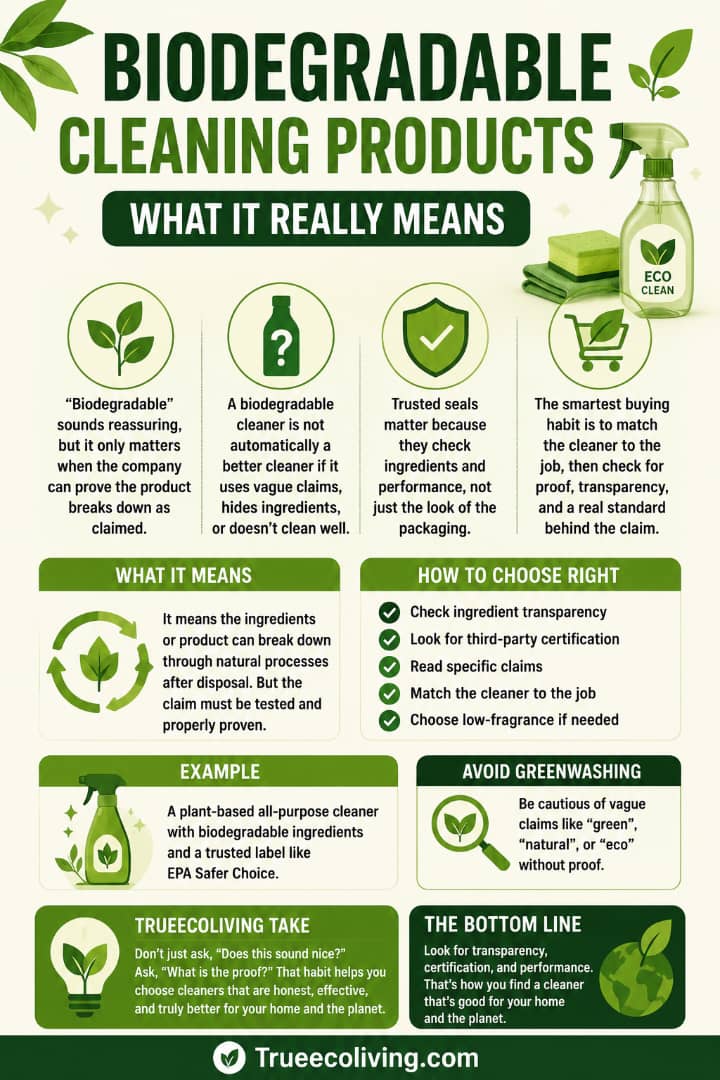
What Biodegradable Cleaning Products Actually Mean
Let us start with the word that gets most of the attention: biodegradable.
In simple terms, biodegradability refers to a product or ingredient breaking down through natural biological processes. That sounds straightforward, but there is a big difference between saying something is biodegradable and explaining how, under what conditions, and according to what test it breaks down.
This is why I never treat the word biodegradable as a magic stamp of approval. It tells me something useful, but it does not tell me everything I need to know about a cleaner.
A biodegradable product can still have packaging concerns, strong fragrance, ingredients that are not suitable for every household, or weak cleaning performance. In other words, biodegradability is one piece of the puzzle, not the whole puzzle.
The FTC Green Guides are useful here because they explain why broad environmental claims need to be specific and properly supported. That is exactly the mindset I use when reviewing these products.
So instead of asking only, “Is this biodegradable?” I ask three better questions: What is in it? How is the claim supported? And does this cleaner actually do the job?
READ ALSO: Biodegradable vs Non Toxic Cleaning Products: Which One Is Actually Safer, Smarter, and Worth Your Money?
What “Bio Friendly” Really Means
You will also come across phrases such as bio friendly, green, natural, and eco friendly. I would be careful with these because they are not interchangeable with a formal certification.
Bio friendly is usually used to describe a product that is being positioned as kinder to people, the environment, or both. It may involve plant based ingredients, reduced use of certain harsh chemicals, environmentally focused packaging, or other design choices.
But the phrase itself does not prove that the product has passed a particular independent test. That is why I use it as a starting point rather than a final verdict.

How I Tell the Difference Between a Good Cleaner and Good Marketing
This is where things get interesting.
A leafy label, words like “green” and “natural,” or a picture of plants can make a cleaner feel environmentally responsible before you have even looked at the ingredients.
I do not automatically distrust those products. I simply do not let the packaging make the decision for me.
The FTC advises marketers to support environmental claims with competent and reliable evidence, and it warns against broad, unqualified claims such as “green” or “eco friendly” when they imply benefits that are difficult to substantiate. That is a useful lesson for shoppers too.
My rule is simple: the bigger the environmental promise, the more evidence I want to see.
Another thing I pay attention to is ingredient transparency. A company that clearly explains what is in the bottle, what each product is designed to clean, and how its environmental claims are supported gives me much more useful information than a bottle covered in attractive marketing language.
Why Certification and Testing Matter
I am especially interested in certifications because they give consumers something more concrete to investigate.
For example, EPA Safer Choice evaluates cleaning product ingredients against health and environmental criteria, while certified products also have to meet performance requirements. In other words, the idea is not simply to approve a product because it sounds safer. The product has to meet a defined standard.
That does not mean every uncertified cleaner is automatically bad. It simply means I have more information to work with when a meaningful standard or test is available.
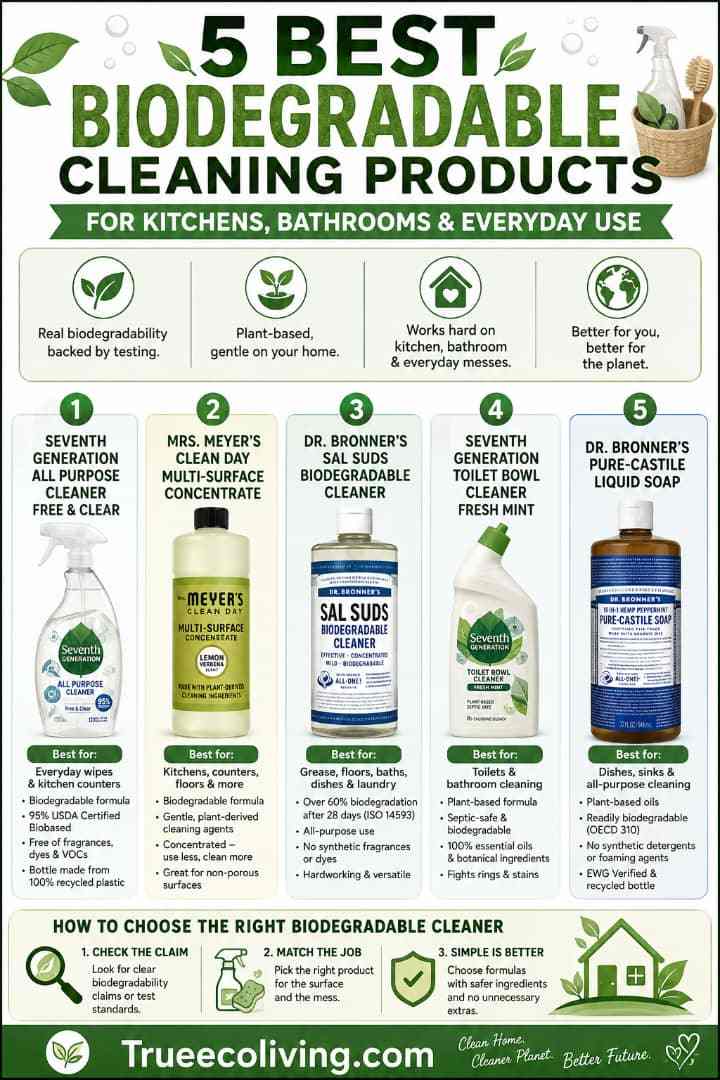
5 Best Biodegradable Cleaning Products for Kitchens, Bathrooms, and Everyday Use
Now let us get to the products.
I chose these five because they cover different cleaning jobs and give us a useful mix of biodegradable claims, bio based ingredients, concentrated formulas, household versatility, and clearer product information.
Quick Comparison Table
| Product | Best For | What Stands Out |
|---|---|---|
| Seventh Generation All Purpose Cleaner Free & Clear | Everyday cleaning and kitchen surfaces | USDA Certified Biobased 95%, fragrance free, dye free and VOC free, with EPA Safer Choice certification |
| Mrs. Meyer’s Clean Day Multi Surface Concentrate | Kitchens, counters and floors | Biodegradable formula, concentrated format and broad non porous surface use |
| Dr. Bronner’s Sal Suds Biodegradable Cleaner | Grease, dishes, floors, laundry and general cleaning | More than 60% biodegradation after 28 days under ISO 14593 |
| Seventh Generation Toilet Bowl Cleaner Fresh Mint | Toilets and bathroom cleaning | Plant based formula, septic safe design and biodegradable claim supported by its safety documentation |
| Dr. Bronner’s Pure Castile Liquid Soap | Dishes and diluted household cleaning | Plant based oils and readily biodegradable testing under OECD Guideline 310 |
BOOKMARK: 15 Best Non Toxic Cleaning Products for a Safer and Eco Friendly Home (2026)
1. Seventh Generation All Purpose Cleaner Free & Clear

This is the kind of cleaner I like to see in an everyday category because it is practical without trying to be everything at once.
Seventh Generation says the Free & Clear formula is USDA Certified Biobased at 95%, is free of fragrances and dyes, and does not contain VOCs. The current product page also lists EPA Safer Choice certification. The bottle is made with 100% post consumer recycled plastic.
For everyday cleaning, that combination makes sense. The product is designed for dirt and grease and can be used across many household surfaces, although the manufacturer also gives specific surfaces where it should not be used, so I would always check the label before spraying.
I especially like the Free & Clear version for households that do not want cleaning fragrance hanging around after a quick wipe down.
2. Mrs. Meyer’s Clean Day Multi Surface Concentrate
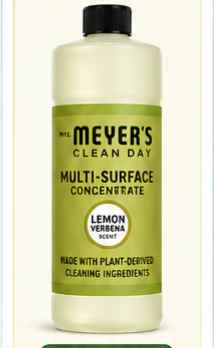
Mrs. Meyer’s is a different proposition because you are buying a concentrate rather than a ready to use spray.
The manufacturer describes the formula as biodegradable and says it is designed for non porous surfaces such as floors and counters. It can also be used in kitchens, bathrooms, and other rooms when diluted according to the directions.
That concentrated format is appealing to me because one bottle can make several cleaning solutions instead of constantly buying a new ready made spray.
One important detail, though, is that biodegradable does not mean fragrance free or ingredient minimal. Current ingredient information includes fragrance and preservatives, so this is a good example of why I always separate the environmental claim from the household preference.
TrueEcoLiving Thought:
A biodegradable cleaner does not need to look perfect. I want it to clean properly, explain itself clearly, and give me enough information to make an informed decision.
3. Dr. Bronner’s Sal Suds Biodegradable Cleaner
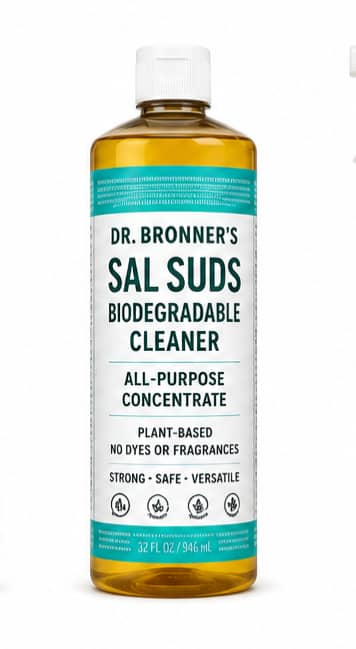
This is probably the most versatile product in the group.
Dr. Bronner’s says Sal Suds is an ultra concentrated biodegradable cleaner that can be used for dishes, floors, laundry and general household cleaning. Its published product information states that Sal Suds shows more than 60% biodegradation after 28 days according to ISO 14593.
That testing detail is exactly the kind of information I look for because it turns a vague environmental statement into something much more specific.
It is also made without artificial fragrances and synthetic dyes according to the manufacturer, with the scent coming from essential oils. Because the formula is concentrated, correct dilution matters. I would follow the manufacturer’s directions rather than guessing.
READ ALSO: 5 Environmentally Safer Cleaning Products That Actually Deserve a Spot Under Your Sink
4. Seventh Generation Toilet Bowl Cleaner Fresh Mint

A toilet cleaner has a very specific job, so I would not replace it with an all purpose cleaner simply because the bottle looks more eco friendly.
Seventh Generation describes this product as a plant based toilet bowl cleaner designed to fight rings and stains. It is septic safe, contains no chlorine bleach, dyes, or artificial fragrances, and the current product page lists USDA Certified Biobased credentials.
The company’s safety data sheet also states that the product is biodegradable based on OECD 301B. That gives the biodegradability claim more substance than a vague phrase on the front of the bottle.
The Fresh Mint version uses essential oils and botanical ingredients for its scent. One detail worth remembering is that essential oils are still ingredients, and some fragrance components can be a concern for sensitive individuals. So again, I would match the product to your household rather than assuming “plant based” automatically means suitable for everyone.
5. Dr. Bronner’s Pure Castile Liquid Soap
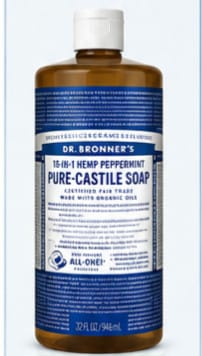
This one is a little different because it is a liquid soap rather than a traditional household spray cleaner, but I think it earns its place because of its flexibility.
Dr. Bronner’s says its Pure Castile Liquid Soaps are made from plant based oils without synthetic detergents or foaming agents. The company also says the soap has been shown to be readily biodegradable under OECD Guideline 310.
When diluted according to the manufacturer’s instructions, it can be used for jobs such as dishes and all purpose household cleaning. That makes it useful for someone who wants a product that can cover several smaller tasks without keeping a huge collection of bottles under the sink.
I would not treat it as a universal replacement for every specialist cleaner. Its strength is flexibility, not the idea that one bottle should solve every cleaning problem.
Which Type of Cleaner Makes Sense for Which Job?
This is where I think many people overcomplicate eco friendly cleaning. You do not need to buy ten different products, but you also do not need to force one cleaner into every job.
- For everyday counters, tables, and light kitchen messes, I would start with an all purpose cleaner.
- For floors and larger cleaning sessions, a concentrate can make more sense.
- For toilets, use a product designed for the bowl.
- For dishes or small household jobs, a flexible liquid soap can be useful.
In my experience, the smartest approach is to build a small cleaning system around the surfaces and problems you actually have. That helps prevent buying products simply because their labels sound impressive.
How I Choose a Good Biodegradable Cleaner
When I am comparing cleaners, I use a simple checklist.
- First, I look at the exact environmental claim. “Biodegradable” is more useful when the company explains the test or standard behind it.
- Second, I check the intended use. A bathroom cleaner and a countertop cleaner are not automatically interchangeable.
- Third, I read the ingredients instead of relying on the front label.
- Fourth, I look for meaningful certification or independent testing where available.
- Finally, I ask the most practical question of all: Does it clean well enough that I will not need half the bottle to finish one job?
Performance belongs in an eco friendly conversation because wasting product, water, time, and packaging is not a great outcome either.
The Easiest Way to Spot Greenwashing
Greenwashing sounds complicated, but spotting the warning signs can be surprisingly simple.
Be cautious when a bottle makes huge environmental promises but gives you very little information about what those promises actually mean. Words such as natural, green, clean, safe, and eco can be useful descriptions, but they should not be your only reason for buying a product.
I especially like this rule: the more dramatic the claim, the more proof I want.
That means looking for ingredient information, specific environmental details, testing standards, certifications, and clear directions. It also means remembering that one positive feature does not automatically make a product better in every other category.
READ ALSO: 5 Natural Cleaning Products That Actually Work: A Practical Guide for a Cleaner Home
What About Non Toxic Cleaning Products?
This distinction is important enough to repeat.
Biodegradable does not mean non toxic. Biodegradable mainly tells you something about breakdown after disposal. Non toxic is a separate claim about toxicity or hazard. A cleaner can have one characteristic without automatically having the other.
The same applies to bio friendly. It is a broad phrase, not a substitute for checking the actual ingredients, certifications, and intended use.
That is why I prefer specific information to broad labels. Specific information gives me something I can actually evaluate.
A Simple Buying Test You Can Use Today
Here is the four question test I personally come back to whenever I am comparing cleaning products:
- What does it clean?
- What exactly makes it biodegradable or bio friendly?
- Is there a test, certification, or meaningful ingredient information behind the claim?
- Does the formula suit my household and the way I actually clean?
That little test can save you from being distracted by beautiful packaging. It also makes comparing products much easier because you are judging them on information rather than advertising style.
I would rather buy a simple bottle that clearly explains what it does than a bottle that makes ten environmental promises but barely explains the formula.
TrueEcoLiving Take
I have become increasingly convinced that the smartest way to buy eco focused cleaning products is to stop shopping by label alone.
Biodegradable is useful. Plant based ingredients can be useful. Recycled packaging can be useful. Certifications can be useful. But none of those details should make us stop asking practical questions.
I want a cleaner that is transparent, effective, and appropriate for the task. When it also has a credible environmental advantage backed by evidence, that makes the product much more interesting to me.
Think of it like this: do not buy the story on the bottle. Buy the evidence behind the story.
- Biodegradable is useful, but it does not automatically mean non toxic, eco friendly, or better in every way.
- The strongest environmental claims are the ones that are specific and supported by testing, standards, or credible certification.
- The five products in this guide cover different jobs, from everyday surfaces and floors to dishes and toilet cleaning.
- I always recommend matching the cleaner to the task instead of choosing a product simply because its packaging looks greener.
- The simplest buying rule is this: look for proof, read the ingredients, check the intended use, and make sure the cleaner actually performs.
DISCOVER: 7 Best Bleach Free Cleaning Products That Actually Work
Conclusion
Biodegradable cleaning products can be a smart part of a greener home, but the label should never be the end of your research.
After looking closely at the claims, formulas, testing information, and everyday uses behind these products, I think the best approach is a practical one.
Choose cleaners that explain themselves clearly, match the job you need done, and give you evidence you can actually understand.
You do not need every cleaner in your home to be perfect. You just need to become better at telling the difference between meaningful environmental information and attractive marketing.
Frequently Asked Questions
Biodegradable generally means the product or its ingredients can break down through natural biological processes. The important detail is how the claim was tested and under what conditions, because the word alone does not tell you the full environmental impact of the product.
No. Biodegradable describes how a product or ingredient breaks down, while non toxic is a separate claim related to toxicity or hazard. A product can be biodegradable without automatically being non toxic.
Bio friendly is generally a broad marketing phrase rather than one universal certification. That is why I recommend looking beyond the phrase and checking the ingredients, specific environmental claims, testing information, and certifications associated with the product.
For everyday surface cleaning, Seventh Generation All Purpose Cleaner Free & Clear is a practical option because the current product information lists it as USDA Certified Biobased 95% and EPA Safer Choice certified, while also describing it as fragrance free, dye free, and VOC free.
Yes. Many biodegradable cleaners are designed for kitchen counters, floors, sinks, and other household surfaces. Toilets are a different job, so a dedicated toilet bowl cleaner can make more sense when you need to handle rings and stains.