

There is a laundry problem I think many of us quietly accept because it has become normal: clothes come out of the washing machine smelling wonderfully “fresh,” yet the collar still feels oily, a child’s shirt still has a food stain, or workout clothes regain that familiar odor after they warm up.
That is why I do not judge a laundry detergent by how natural the label sounds or how strongly the finished laundry smells.
I look deeper. I want to know what is actually in the formula, what those ingredients are designed to do, how the detergent tackles dirt and stains, whether an independent organization has reviewed the product, and what happens to the packaging after the bottle, pouch, tablet, or scoop is gone.
That matters even more when you are deliberately trying to reduce ingredients you would rather minimize in your home, including synthetic fragrance, phthalates, optical brighteners, and methylisothiazolinone.
There is also an important distinction I want to make from the start. “Non-toxic” is not a scientific guarantee that a detergent contains absolutely nothing capable of causing irritation or harm.
I use the term here as practical consumer shorthand for products with stronger ingredient transparency, sensible ingredient exclusions, and meaningful third-party screening where available.
The EPA’s Safer Choice program is one of the resources I look at when researching household cleaners because it evaluates ingredients as part of a broader standard that also considers product performance and environmental factors.
So I tested many of these detergents with one question in mind:
Which products give you genuinely clean clothes without forcing you to choose between cleaning performance, ingredient transparency, and a more thoughtful environmental footprint?
Here are the seven I currently consider worthy of the shortlist.
7 Best Non-Toxic Laundry Detergents at a Glance
| Detergent | Best For | Format | Ingredient Approach | Verification | Cleaning Focus | Eco Advantage |
|---|---|---|---|---|---|---|
| ATTITUDE Nature + Unscented | Best Overall | Liquid | Fragrance-free, transparent formulation | EWG Verified | Everyday laundry | Concentrated and refill options |
| Dirty Labs Bio Free & Clear | Tough stains and odors | Liquid | Enzyme-based, fragrance-free | EWG Verified | Stain and odor removal | Ultra-concentrated |
| Branch Basics Laundry Detergent | Strict ingredient avoidance | Powder | No fragrance, optical brighteners, ethoxylates, or 1,4-dioxane according to brand | Brand-disclosed formulation | Everyday and stained laundry | Dry concentrated format |
| Meliora Unscented Laundry Powder | Minimalist laundry | Powder | Very short ingredient list | MADE SAFE Certified | Ordinary soil | Low packaging impact |
| Blueland Fragrance-Free Laundry Tablets | Plastic-free convenience | Tablet | Fragrance-free, enzyme-based | EWG Verified | Everyday stains | No dissolvable PVA film |
| AspenClean Zero Plastic Unscented | Eco-focused households | Powder | Fragrance-free, disclosed formulation | EWG Verified | Everyday laundry | Zero-plastic format |
| Green Llama Fragrance-Free | Fragrance-free powder | Powder | Enzyme-based, fragrance-free | EWG Verified | Stain-focused laundry | Concentrated dry formula |
How I Chose These 7 Non-Toxic Laundry Detergents
I did not start with the prettiest bottles or the loudest “clean living” claims. I started with ingredients.
I looked for detergents that give consumers a credible way to reduce synthetic fragrance, optical brighteners, and methylisothiazolinone while still using cleaning chemistry capable of dealing with real laundry.
I also looked carefully at 1,4-dioxane. It is not normally something deliberately added to laundry detergent. It can occur as a manufacturing byproduct or contaminant associated with certain ingredients and processes.
That means simply failing to see the words “1,4-dioxane” on a label does not prove that a product contains none. The EPA explains this issue in its 1,4-dioxane risk management information.
Then I looked at the cleaning chemistry. Enzymes such as protease, amylase, cellulase, and mannanase have different jobs against different kinds of soil. Protease can help break down protein-based stains, while other enzymes target starches, plant residues, and other organic soils.
Finally, I checked whether an independent organization such as EWG or MADE SAFE reviews the specific product rather than assuming every claim made by a brand applies equally to every formula.
That is a much higher bar than simply calling something “natural.”
BOOKMARK: 15 Low Waste Laundry Tips for an Eco-Friendly Environment at Home
Best Non-Toxic Laundry Detergents That Actually Clean Clothes
1. ATTITUDE Nature + Laundry Detergent, Unscented
Best Overall for Everyday Family Laundry

ATTITUDE takes the first spot because it offers a useful balance between everyday convenience, ingredient transparency, and a fragrance-free option.
The unscented ATTITUDE Nature + Laundry Detergent is listed as EWG Verified, with a disclosed ingredient list that includes sodium coco sulfate, glucosides, sodium citrate, sodium gluconate, sodium benzoate, and potassium sorbate.
What I particularly like is the unscented choice. When someone tells me they want to simplify what stays on their clothes, I would rather start with fragrance-free than assume that an added scent automatically means cleaner laundry.
ATTITUDE also offers concentrated and refill-oriented products across its laundry range, giving environmentally conscious shoppers ways to reduce packaging.
My takeaway: This is the option I would look at first for someone who wants an uncomplicated everyday switch.
2. Dirty Labs Bio Laundry Detergent with Phytolase Free & Clear
Best for Tough Stains, Body Oils, and Odors
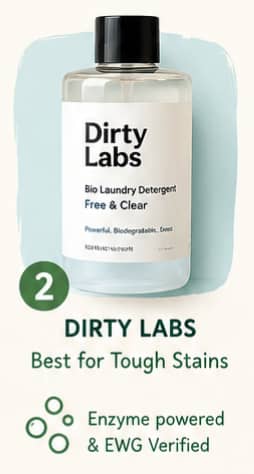
This is the formula that most directly answers the question behind this article: can a more thoughtfully formulated detergent still be serious about cleaning?
Dirty Labs uses a concentrated enzyme-based formula containing protease, mannanase, amylase, pectate lyase, and cellulase. The Free & Clear version is unscented.
That enzyme combination is why I pay so much attention to this product. Different enzymes can target different categories of organic soil, giving the detergent more stain-fighting tools than an extremely minimalist powder.
EWG lists the Free & Clear formula as EWG Verified for general-purpose and HE laundry. The concentrated format also means you use a relatively small amount per load.
My takeaway: For stains, body oils, and persistent odors, Dirty Labs is the product I would investigate first.
3. Branch Basics Laundry Detergent
Best for a Strict Ingredient-Avoidance List
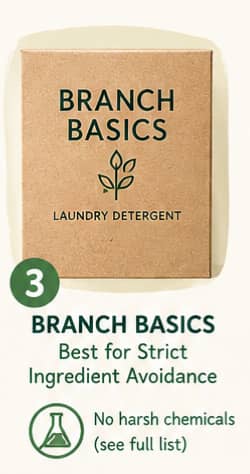
Branch Basics caught my attention because its current laundry powder makes its exclusion list unusually clear.
The company says the formula contains no 1,4-dioxane, phosphates, sulfates, ethoxylates, optical brighteners, bleach, ammonia, or dyes. It also discloses ingredients including sodium carbonate, sodium percarbonate, sodium gluconate, sodium metasilicate, decyl glucoside, protease, and amylase.
I like that the formula includes enzymes because this gives it a more purposeful stain-fighting system than a powder relying mainly on washing soda and soap.
One important distinction: I would not describe this specific laundry powder as EWG Verified or MADE SAFE Certified unless the current product itself carries that certification. Its strongest case here is its published formulation and ingredient-avoidance policy.
My takeaway: This is one of the more interesting choices for shoppers with a very specific list of ingredients they want to avoid.
4. Meliora Laundry Powder, Unscented
Best Minimalist Detergent
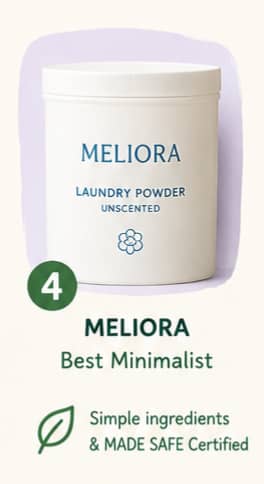
Sometimes I think the laundry aisle has forgotten that a detergent does not need a frighteningly long ingredient list.
Meliora goes in the opposite direction. Its unscented powder uses a very short formulation built around washing soda, baking soda, and vegetable soap.
That simplicity is appealing if your goal is to remove unnecessary complexity from your laundry routine. Meliora’s laundry powder is also MADE SAFE Certified.
There is a trade-off, though. A minimalist powder is not the same cleaning system as an enzyme-rich detergent. For ordinary dirt, clothing, towels, and bedding, Meliora can make a lot of sense. For heavily stained or oily laundry, I would expect an enzyme-based formula or separate stain treatment to have the advantage.
My takeaway: Meliora makes the most sense when simplicity and lower packaging impact matter more than maximum stain-fighting power.
5. Blueland Laundry Detergent Tablets, Fragrance Free
Best Plastic-Free Tablet Option

Blueland tackles a different laundry problem: packaging.
Instead of shipping a large bottle filled mostly with liquid, its laundry detergent comes in concentrated dry tablets. The fragrance-free version is EWG Verified and uses several cleaning ingredients, including enzyme blends.
Blueland also says its laundry tablets do not use a dissolvable PVA or PVOH film. The company says the fragrance-free formula avoids ingredients including phthalates and methylisothiazolinone.
That combination is what makes this interesting to me. You are not simply choosing a lower-packaging product and hoping it cleans well. The formula is designed for everyday stains while keeping dosing simple.
My takeaway: This is one of the clearest choices for someone who wants less packaging and convenient pre-measured detergent.
DISCOVER: 15 Best Non-Toxic Cleaning Products for a Safer and Eco Friendly Home (2026)
6. AspenClean Zero Plastic Laundry Powder, Unscented
Best for an Eco-Focused Household

AspenClean stands out because its laundry range goes beyond one green claim. The brand offers fragrance-free formats, and EWG lists current AspenClean laundry products as Verified.
The product I would highlight is the AspenClean Zero Plastic Laundry Powder Detergent + Booster, Unscented.
The zero-plastic format is especially attractive if the environmental side of laundry matters as much as the cleaning side. A dry powder can reduce packaging and transport weight compared with a large liquid bottle, while the zero-plastic format pushes that approach further.
I also like the unscented option because eco-friendly and fragrance-free do not need to be competing goals.
My takeaway: AspenClean is a strong fit for someone who wants independent ingredient screening alongside serious packaging reduction.
7. Green Llama Laundry Powder, Fragrance Free
Best Fragrance-Free Powder with Enzyme Cleaning

Green Llama is less familiar than some of the names above, but I think it deserves attention.
Its fragrance-free laundry powder is EWG Verified, with a formulation that includes sodium carbonate, sodium citrate, sodium percarbonate, decyl glucoside, sodium metasilicate, TAED, amylase, and protease.
What I like is the balance. It remains a powder with a relatively understandable formulation, but it also includes enzymes and an oxygen-based cleaning component. That gives it a more performance-focused approach than an ultra-minimalist powder.
My takeaway: This is a good option for someone who wants a fragrance-free powder without giving up enzyme-based cleaning chemistry.
What About 1,4-Dioxane?
This deserves a section of its own because online laundry articles often explain it poorly.
1,4-dioxane is not normally something a manufacturer intentionally adds to laundry detergent. It can be produced as a byproduct during certain manufacturing processes and can remain as a contaminant in consumer products such as soaps and detergents. EPA’s current information explains this distinction.
That means I would not tell readers to simply scan a bottle for the words “1,4-dioxane.” Instead, I would favor brands that disclose formulations clearly and, where possible, explain how they address ethoxylated ingredients and manufacturing contaminants.
This is one reason Branch Basics caught my attention because its current product information specifically addresses ethoxylates and 1,4-dioxane.
Don’t Overlook this: 9 Non-Toxic Cleaning Mistakes That May Be Making Your Home Dirtier Than You Think
Why I Prefer Fragrance-Free Laundry Detergent
There is nothing wrong with wanting laundry to smell pleasant. I understand the appeal.
But I stopped treating fragrance as evidence of cleanliness.
Clean clothes do not have to smell strongly.
Strong fragrance can even make it harder to tell whether a detergent removed an odor or simply covered it.
When someone is trying to simplify their laundry routine, I generally prefer starting with an unscented option. That removes one unnecessary variable and makes the detergent’s actual cleaning performance easier to judge.
I would also check the exact product rather than assuming every formula from the same brand has the same ingredient profile.
What I Would Avoid When Shopping for Laundry Detergent
Vague fragrance. If reducing fragrance is the goal, choose an explicitly fragrance-free formula.
Optical brighteners. They can make fabrics appear brighter, but that is not the same as actually removing soil.
Methylisothiazolinone when avoiding it is a priority. Check the exact ingredient list for the product you are buying.
Marketing without evidence. A transparent ingredient list and meaningful certification tell me far more than a leaf printed on the front of a bottle.
How to Get Better Cleaning From a Non-Toxic Laundry Detergent
Even a well-formulated detergent can disappoint when it is used incorrectly.
Start by following the manufacturer’s dosing directions. More detergent does not automatically mean cleaner clothes, and excessive detergent can contribute to residue.
Think about soil level too. A lightly worn shirt and greasy work clothes are completely different cleaning jobs.
For stubborn stains, pretreatment can make a big difference. Enzyme-rich detergents have useful chemistry for organic stains, but they still need sufficient contact with the soil.
Water temperature matters as well. Some modern formulations are designed to perform well in cold water, which can reduce the energy used during laundry.
Most importantly, choose around your actual laundry.
If you mostly wash lightly soiled clothing, towels, and bedding, a minimalist powder may be enough.
If you regularly wash sportswear, children’s stained clothes, or greasy garments, I would lean toward an enzyme-rich formula.
If packaging waste is your biggest concern, a dry tablet or concentrated powder deserves extra attention.
Where I Verify Laundry Detergent Safety Claims
One habit I have developed while researching household products is checking an independent database instead of stopping at the manufacturer’s website.
The EPA Safer Choice program is one of the first places I look. EPA says the program evaluates every chemical ingredient in certified products and also considers factors such as product performance and packaging.
I also compare independent product databases with manufacturer disclosures. I do not treat an EWG rating as interchangeable with government certification because different programs use different criteria.
Which of These 7 Would I Choose?
I would match the detergent to the laundry problem instead of asking which bottle sounds the most “clean.”
- For everyday family laundry: ATTITUDE Nature + Unscented.
- For difficult stains and odors: Dirty Labs Free & Clear.
- For strict ingredient avoidance: Branch Basics.
- For minimalist laundry: Meliora Unscented.
- For convenient plastic-free tablets: Blueland Fragrance Free.
- For lower-packaging laundry with independent screening: AspenClean Zero Plastic Unscented.
- For a fragrance-free powder with enzyme cleaning: Green Llama.
Notice the pattern: there is no single detergent that dominates every category. A minimalist powder does not have to outperform an enzyme-rich formula on greasy stains, and impressive packaging does not automatically mean impressive cleaning chemistry.
That is how I think about non-toxic laundry.
It is not about finding a magical bottle that solves every household concern at once.
It is about making a better-informed choice without giving up the basic purpose of detergent: getting your clothes genuinely clean.
5 Key Things to Remember
- Look beyond “natural.” I would rather see a transparent ingredient list and meaningful third-party verification than a vague green claim.
- Fragrance-free is a useful starting point. It removes one unnecessary variable when your goal is to reduce fragrance ingredients.
- 1,4-dioxane is different from an intentionally added ingredient. It can occur as a manufacturing byproduct or contaminant, so formulation transparency matters.
- Cleaning performance still matters. Enzyme-rich detergents have useful advantages when laundry contains complex stains and odors.
- Choose around your household. Consider soil level, fragrance preference, ingredient screening, washing machine compatibility, packaging, and how much stain-fighting power you actually need.
Conclusion
After digging through the current formulations, ingredient disclosures, and certification information, I am much more comfortable with this shortlist than with a generic list of “natural” laundry detergents.
What I like about these seven is that they represent different ideas of better laundry.
- ATTITUDE gives you a practical everyday option.
- Dirty Labs brings serious enzyme-based cleaning chemistry.
- Branch Basics stands out for its strict ingredient-avoidance approach.
- Meliora keeps the formula remarkably simple.
- Blueland tackles packaging with dry tablets.
- AspenClean combines ingredient screening with a zero-plastic format.
- Green Llama gives fragrance-free powder shoppers an enzyme-based alternative.
And that is the point I keep coming back to.
You do not have to choose between cleaner clothes and a more thoughtful laundry routine.
You just need to stop assuming that a strong scent, a “natural” label, or a green bottle tells you whether a detergent actually deserves a place in your home.
Read the ingredients. Check the certification. Understand the cleaning chemistry. Look at the packaging. Then choose the formula that makes sense for the clothes you actually wash.
Frequently Asked Questions
There is no universal legal definition of a non-toxic laundry detergent. In this guide, I use the term for products with stronger ingredient transparency, sensible ingredient exclusions, fragrance-free options, and credible third-party screening where available.
Dirty Labs Bio Laundry Detergent Free & Clear is the strongest option in this list for tough stains and odors because its formula uses several enzymes designed to target different types of organic soil.
Fragrance-free detergent can be a sensible choice when your goal is to reduce unnecessary fragrance ingredients or potential irritants. It also makes it easier to tell whether the detergent is actually removing odors rather than simply covering them.
Yes. The better formulas use proven cleaning chemistry such as surfactants, builders, oxygen-based ingredients, and enzymes. The key is choosing a formulation suited to the type of soil and stains you regularly wash.
Start with your actual laundry needs. Choose an enzyme-rich detergent if you regularly wash stains, sportswear, or heavily soiled clothing. Choose a minimalist powder if simplicity is your priority, or a dry tablet or zero-plastic powder if packaging reduction matters most.