
Have you ever considered switching to laundry detergent sheets because they promise less plastic, less waste, and a more sustainable way to wash clothes? I understand the appeal.
A small, lightweight sheet seems like an easy way to make laundry more environmentally friendly.
But I believe choosing a sustainable cleaning product requires looking beyond the packaging. How well does it clean? What does each wash actually cost? And are you genuinely reducing waste, or simply changing the type of waste you produce?
These are the questions I consider when evaluating eco-friendly cleaning products.
In this comparison, I examine laundry detergent sheets and powder detergents from the perspective of cleaning performance, affordability, environmental impact, and everyday practicality.
My goal is not to convince you that one format is always better. It is to help you understand the trade-offs and choose a detergent that works for your laundry routine without creating unnecessary waste.
5 Things to Know Before Choosing Between Laundry Sheets and Powder
- Cleaning performance: Powder generally has the advantage, particularly when you choose a well-formulated product designed to tackle dirt, body oils, and everyday stains.
- Cost: Powder is often more affordable per load, although premium products can narrow the price difference.
- Packaging waste: Laundry sheets usually come in compact paper packaging, while powder is available in cardboard boxes and plastic bags.
- Environmental impact: Both formats can reduce packaging waste compared with conventional liquid detergents, but the ingredients, packaging materials, and amount used per wash matter.
- Convenience: Sheets are lightweight and easy to carry, while powder offers flexibility when choosing products and adjusting the dose for different loads.
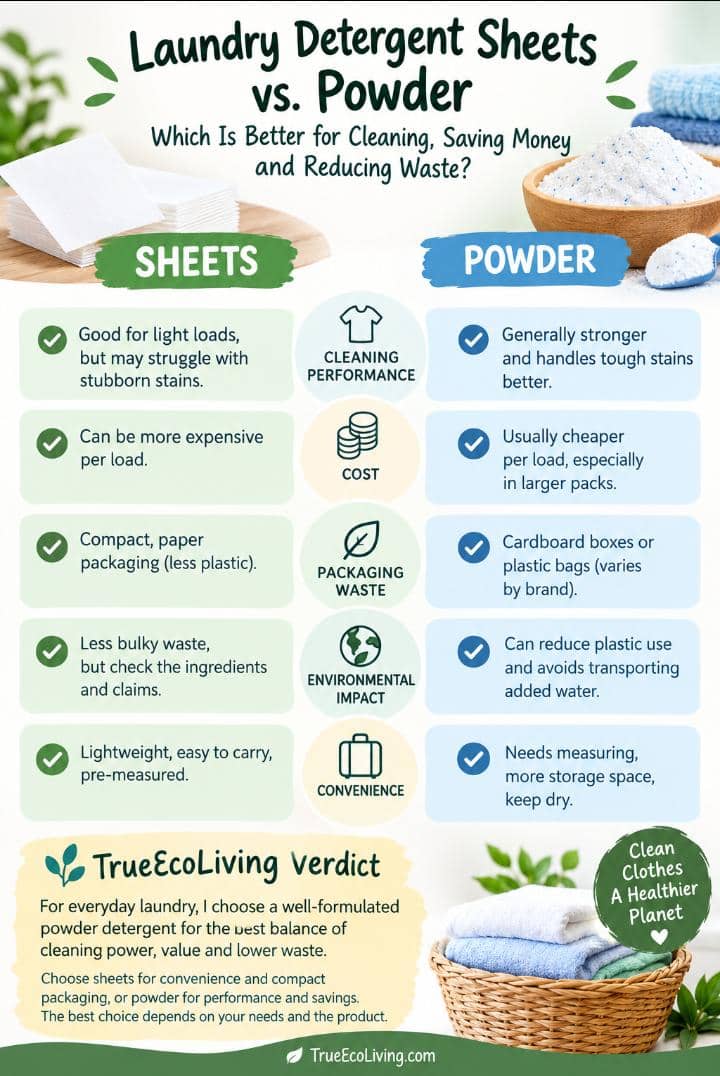
Laundry Detergent Sheets vs. Powder: A Quick Comparison
| Feature | Laundry Detergent Sheets | Powder Detergent |
|---|---|---|
| Cleaning performance | May struggle with stubborn stains | Generally stronger with a good formula |
| Everyday laundry | Suitable for lightly soiled clothes | Suitable for everyday and heavily soiled laundry |
| Cost per load | Can be relatively expensive | Often cheaper, especially with budget brands |
| Packaging | Usually compact paper packaging | Cardboard boxes or plastic bags |
| Storage | Lightweight and space-saving | Requires more storage space |
| Measuring | Convenient, pre-measured portions | Requires a scoop or other measuring method |
| Cold-water washing | Dissolving performance varies by product | Some products may leave residue if they do not dissolve properly |
| Waste reduction | Reduces bulky packaging | Can also reduce packaging waste when sold in cardboard |
| Best for | Convenience and compact packaging | Value, cleaning versatility, and everyday use |
The most important distinction is that the format alone does not determine whether a detergent is effective or environmentally responsible. Formulation, dosing, packaging, and washing habits also matter.
1. Cleaning Performance: Do Laundry Sheets Clean as Well as Powder?
This is where I would begin when making a purchasing decision.
After all, detergent has one main job: to remove dirt, body oils, unpleasant odours, and stains from clothing.
A product can have attractive packaging and impressive environmental claims, but if it repeatedly leaves clothes looking dirty, it may not be the practical choice.
How Well Do Laundry Detergent Sheets Work?
Laundry sheets are thin, pre-measured detergent products designed to dissolve in water during a wash. They are appealing because they eliminate the need to pour liquid detergent or measure loose powder.
For lightly soiled everyday clothing, a suitable sheet may provide satisfactory results. However, performance varies between brands, and difficult stains can expose the limitations of some formulas.
Independent laboratory testing by Consumer Reports found that laundry detergent sheets generally performed poorly against a range of stains, including body oils, dirt, grass, and coffee.
You can read its laundry detergent performance tests for a closer look at the differences between detergent products.
I consider this an important reminder that convenience and cleaning power are two separate things.
Imagine washing school uniforms, sweaty sportswear, kitchen towels, or clothes stained during outdoor activities. These loads may require more effective stain-removing ingredients than a lightly soiled shirt.
Some sheets may struggle with these demands. Pretreating stains can help, but that introduces another step and potentially another product.
Bookmark: 7 Best Non-Toxic Laundry Detergents That Actually Clean Clothes
How Does Powder Detergent Perform?
Powder has a strong practical advantage: well-formulated products can deliver effective cleaning at a relatively low cost per load.
Depending on the formulation, powder detergents may contain surfactants that loosen dirt and oils, enzymes that help break down certain stains, and other ingredients that improve cleaning.
Consumer Reports’ testing found that some powder detergents performed well against body oils, dirt, and blood stains. However, powder is not automatically superior in every situation. Performance differs between brands and individual formulas.
I would pay particular attention to the detergent’s ability to handle the types of stains common in my household rather than relying on claims such as extra power or natural cleaning.
There is also an important limitation.
Powder may not dissolve completely under certain washing conditions. Using too much detergent, washing in unsuitable conditions, or selecting a product that performs poorly in your machine can leave residue on clothing.
My practical takeaway: I would generally favour a well-formulated powder for overall cleaning versatility. I would consider sheets when convenience matters more than heavy-duty stain removal.
2. Cost: Which Detergent Gives You More for Your Money?
I believe cost should be assessed per wash rather than by looking at the price of the entire package.
A small box of detergent sheets might seem affordable until you calculate how many loads it actually handles. Similarly, a large bag of powder is not necessarily economical if you must use a generous amount for satisfactory results.
Are Laundry Sheets Expensive?
Laundry sheets are often sold in packages containing a fixed number of washing portions.
This makes measuring relatively straightforward, but the price per load can vary considerably between brands.
For example, a pack costing 8,000 in your local currency and advertised for 40 washes costs 200 per wash.
If you need two sheets for certain loads, that cost becomes 400 per wash.
These figures are illustrative calculations, not current retail prices.
The same principle applies to powders. Always calculate the price based on the manufacturer’s recommended dose for the load size you typically wash.
Is Powder Detergent Cheaper?
Powder is often the more economical option, particularly when purchasing a product with good cleaning performance in a larger package.
However, I would not automatically choose the cheapest powder available.
A poorly performing detergent may encourage you to add more product, pretreat more clothing, or repeat a wash. Those extra steps can reduce the apparent savings.
For a fair comparison, look at three things:
- The purchase price divided by the number of recommended washes.
- Whether the product cleans satisfactorily at the recommended dose.
- Whether you need additional products to tackle common stains.
I would also consider how easily each product is available locally. An imported sheet detergent may cost substantially more than a good powder available at a nearby shop.
My verdict on cost: Powder is usually the better starting point for households trying to reduce laundry expenses. Sheets are worth considering when their convenience justifies any price premium.
READ ALSO: Cleaning Concentrates vs Refill Tablets: Which Is Actually Cheaper and Greener?
3. Environmental Impact: Which Creates Less Waste?
This comparison is more interesting than it first appears because both products can help reduce unnecessary packaging.
However, I would avoid declaring either option automatically sustainable simply because it is marketed as eco-friendly.
Laundry Detergent Sheets and Packaging Waste
One of the biggest attractions of sheets is their compact packaging.
Many brands use small cardboard or paper packages instead of bulky liquid detergent bottles. This can reduce the amount of packaging entering the household waste stream.
Their lightweight format also makes them convenient to transport and store.
However, there is a detail worth understanding: the packaging and the sheet itself are two different things.
A paper package does not necessarily mean the detergent sheet contains no synthetic polymers. Some formulations use water-soluble materials to hold the detergent together.
I would therefore be cautious about treating phrases such as plastic-free or biodegradable as sufficient evidence on their own.
The important questions are what the product contains, what the packaging is made from, and how well supported the manufacturer’s environmental claims are.
Powder Detergent and Packaging Waste
Powder also has environmental advantages.
Because it is sold in dry form, it does not require the same transport of added water as a conventional liquid detergent. It may also be available in cardboard boxes, which can reduce dependence on plastic packaging.
Nevertheless, not every powder product comes in recyclable packaging. Some are sold in plastic bags or containers.
I would check the actual packaging rather than assuming every powder is environmentally preferable.
There is also the issue of product waste. Spilling powder, measuring unnecessarily large amounts, or buying more detergent than you need can undermine the benefits of choosing a lower-waste product.
What About the Detergent Itself?
Packaging is only one part of the environmental picture.
The ingredients, production process, quantity used, and behaviour after the detergent enters wastewater systems also matter.
Neither sheets nor powder should automatically be considered harmless to aquatic environments simply because the product uses paper packaging or contains some plant-derived ingredients.
I recommend looking for transparent ingredient information and credible environmental claims rather than relying exclusively on green branding.
My environmental takeaway: Both formats can be reasonable choices. Sheets offer compact packaging, while powders can combine effective cleaning with cardboard packaging and relatively low cost. The better option depends on the specific product and how you use it.
4. Convenience: Which Fits Your Laundry Routine?
This is where laundry sheets have a genuine advantage.
They are lightweight, take up little storage space, and require little measuring. If you travel frequently, live in a small home, or dislike handling loose detergent, sheets may suit your routine.
Their pre-measured format can also reduce the temptation to pour in too much detergent.
Powder requires a little more attention. You need to measure the dose, keep the package dry, and avoid spilling the product.
However, powder can offer flexibility. You can follow the recommended dosage for different load sizes and select formulations suited to your washing needs.
Both formats require attention to the washing machine’s instructions.
For either product, check whether it is compatible with your machine, particularly if you use a high-efficiency washer. Follow the dosage instructions and make sure the detergent dissolves properly under your normal washing conditions.
If you regularly wash heavily soiled clothing, I would prioritise cleaning performance over the convenience of a pre-measured sheet.
If your laundry is generally lightly soiled and storage space is limited, sheets may be more attractive.
5. How to Make Either Option More Eco-Friendly
I believe sustainable laundry is about more than buying the product with the greenest packaging.
Your everyday habits can make a meaningful difference to how much detergent and other resources you use.
Here are five practical steps I recommend.
- Measure detergent correctly. More detergent does not automatically produce cleaner clothing. Follow the label, taking load size and soil level into account.
- Treat stubborn stains before washing. Appropriate pretreatment can reduce the likelihood of needing another complete wash.
- Choose suitable washing settings. Use a temperature and cycle appropriate for the fabric, the detergent, and the level of soiling.
- Avoid unnecessary rewashing. Choose a detergent that handles your usual laundry effectively, and check whether stains need separate treatment before washing.
- Consider packaging at the point of purchase. When comparing otherwise suitable products, look for packaging that minimises unnecessary material and can be reused or recycled through systems available in your area.
These habits help shift the focus from simply buying an eco-friendly product to making the entire washing routine more efficient.
DISCOVER: 15 Low Waste Laundry Tips for an Eco-Friendly Environment at Home
TrueEcoLiving Verdict: Laundry Detergent Sheets vs. Powder
After comparing cleaning performance, price, packaging, and convenience, I would generally choose a well-formulated powder detergent as the better all-round option for everyday household laundry.
My reasoning is straightforward: powder can provide good cleaning performance at a comparatively affordable cost, and it is available in packaging that may reduce plastic waste.
Laundry sheets still have a place.
They can be useful for people who value portability, compact storage, and the convenience of pre-measured portions.
However, the weaker cleaning performance found in many tested products means I would be cautious about relying on them for heavily soiled clothing or stubborn stains.
I would also avoid assuming that every sheet is environmentally superior simply because it comes in a paper package.
Ultimately, I want an eco-friendly cleaning product to satisfy three conditions: it should work effectively, offer reasonable value, and avoid unnecessary environmental harm.
For me, powder is the stronger starting point. A well-performing detergent in appropriate packaging, used in the correct amount, is a more sensible purchase than an expensive product that relies on impressive sustainability claims without delivering the cleaning results I need.
The bottom line: Choose powder for value and cleaning versatility, or consider sheets when convenience and compact packaging are your priorities. Either way, judge the individual product rather than the marketing.
Frequently Asked Questions
Not necessarily. Sheets often come in compact paper packaging, reducing the need for bulky plastic detergent bottles. Powder can also come in cardboard packaging and avoids transporting added water. Ingredients, packaging, cleaning efficiency, and proper dosing all influence the environmental impact
Some sheets can handle lightly soiled everyday laundry, but performance varies by brand. Independent testing has found that many struggle with stubborn stains and body oils. If you regularly wash heavily soiled clothing, compare cleaning performance carefully before choosing sheets.
Powder is often cheaper per load, particularly when purchased in larger packages. However, prices vary by brand and location. Divide the purchase price by the number of recommended washes to make a fair comparison, and account for any additional product needed for heavily soiled loads.
Both types are available in formulations intended for cold-water washing, but dissolving performance varies. Check the manufacturer’s instructions for your particular detergent and washing machine. With powder, avoid excessive dosing, which can contribute to residue. With sheets, follow the directions for placing the product in the machine and preparing the load.