

A clean kitchen should not leave you wondering whether you simply traded one problem for another.
We have all seen the bottles promising a greener, cleaner, more natural home. But once you actually use them, the story can be very different. A spray may look beautiful on the shelf but struggle with dried sauce.
A product may call itself eco friendly while still leaving you with another bulky plastic bottle. And “natural” on the label does not automatically tell you what is inside.
I have learned that choosing kitchen cleaners is much easier when you stop shopping by buzzwords and start looking at three things: what the product is designed to clean, what the brand can actually prove about the formula, and what happens to the packaging after you finish using it.
That is exactly what I focused on here. I combined everyday performance, ingredient transparency, certification information, versatility, and lower waste considerations to create one practical list instead of another collection of pretty green bottles.
By the end, you will know which products make sense for counters, grease, dishes, baked on messes, and dishwashers, plus how to build a small kitchen cleaning setup without filling the cabinet with products you barely use.
And for the bigger picture, you can also read our Top Non Toxic and Eco Friendly Cleaning Products guide.
In a Nutshell
- Non toxic and eco friendly are not identical terms. One focuses more heavily on ingredient and exposure considerations, while the other also considers packaging, waste, sourcing, and broader environmental impact.
- Certification is more useful than vague green language. EPA Safer Choice evaluates safer ingredients and product performance, while EWG Verified has its own ingredient transparency and safety criteria.
- The job matters. A countertop spray, dish soap, degreaser, cleaning paste, concentrate, and dishwasher tablet are designed for different tasks.
- Concentrates and refill systems can simplify your kitchen. They can reduce the number of bottles you need and may reduce packaging waste over time.
- You do not need ten cleaners just because this article has ten products. I am giving you options. Your actual kitchen may only need three or four categories.
Quick Comparison Table
| Product | Best For | What Makes It Stand Out |
|---|---|---|
| ATTITUDE Kitchen Cleaner | Daily kitchen surfaces | EWG Verified and made with more than 97% naturally derived ingredients |
| Seventh Generation All Purpose Cleaner | Everyday grease and grime | EPA Safer Choice, USDA Biobased, recycled plastic packaging |
| Branch Basics Concentrate | Multiple cleaning jobs | Concentrated refill style system |
| Dr. Bronner’s Sal Suds | Multipurpose cleaning | Highly concentrated biodegradable cleaner |
| Method Heavy Duty Degreaser | Grease and cooking buildup | Designed for tough kitchen messes and recycled plastic bottle |
| Stardrops The Pink Stuff | Stubborn grime | Mild abrasive paste for tough cleaning tasks |
| ATTITUDE Dish Soap | Hand washing dishes | EWG Verified, 97% naturally derived ingredients, refill options |
| Blueland Dishwasher Tablets | Dishwasher cleaning | 100% plastic free tablet format |
| ECOS All Purpose Cleaner | Everyday hard surfaces | Plant derived cleaning ingredients and eco conscious manufacturing approach |
| Seventh Generation Dish Soap | Greasy dishes | EPA Safer Choice and USDA Biobased 95% for the Yuzu Basil version |
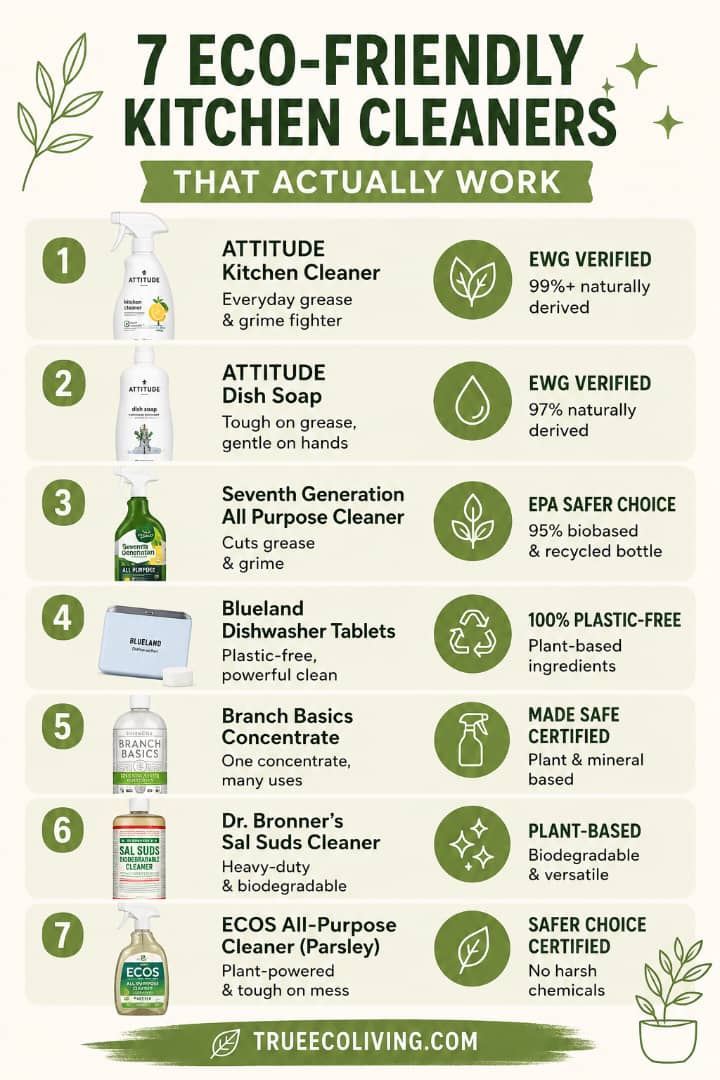
What Does Non Toxic Really Mean?
This is the first distinction I want to make because “non toxic” is one of those phrases that can sound more precise than it actually is.
When I evaluate a cleaning product, I do not treat the words “natural,” “green,” or “non toxic” as proof on their own. I want to know more. What ingredients are disclosed? What standards does the product meet? Does the manufacturer explain what is deliberately left out? Is there an independent certification or verification attached to the claim?
That is where programs such as EPA Safer Choice and EWG Verified become useful reference points. The EPA Safer Choice program helps consumers find cleaning products that meet its safer ingredient and performance standards. EWG Verified uses its own criteria focused on ingredient safety, transparency, and related standards.
Neither label means that you should stop reading the instructions or ignore how a cleaner is meant to be used. A product can have a stronger ingredient profile while still needing proper ventilation, careful surface selection, or specific handling.
For me, the bigger lesson is simple: look for evidence, not just adjectives.
What Makes a Kitchen Cleaner Eco-Friendly?
Eco friendly is a broader question than simply asking what is inside the bottle.
I look at the whole product. Does it come in a refill format? Is the packaging made with recycled material? Can a concentrated formula replace several bottles? Does the product avoid unnecessary packaging? Does the brand provide enough information for me to understand what I am buying?
This matters because a kitchen cleaner is not only a chemical formula. It is also a bottle, trigger, box, tablet, pouch, refill, shipping package, and repeat purchase.
Blueland is a good example of the packaging side of the conversation because its current dishwasher tablets are sold in a plastic free format and refill system. Seventh Generation provides another angle, with its Yuzu Basil All Purpose Cleaner currently described as USDA Certified Biobased 95 percent and packaged in a bottle made with 100 percent recycled plastic.
I do not see one sustainability feature as a magic pass. A product can have excellent packaging and still not be the right cleaner for your kitchen. That is why I consider both performance and environmental design.
Non-Toxic vs Eco-Friendly: What’s the Difference?
| Non Toxic Focus | Eco Friendly Focus | |
|---|---|---|
| Main question | What is in the formula? | What is the overall environmental impact? |
| Looks at | Ingredients, transparency, safety standards | Ingredients, packaging, waste, refills, sourcing |
| Helpful signals | Ingredient disclosure and certification | Refill systems, recycled or plastic free packaging, recognized standards |
| Can they overlap? | Yes | Yes |
Think of it like this: non toxic asks you to look closely at the product, while eco friendly asks you to look at the product and the bigger system around it.
That distinction is important because a cleaner can perform well on one dimension and differently on another. I would rather explain that honestly than label every product “perfectly green.”
Learn more: Eco Friendly vs Non Toxic vs Biodegradable Cleaners: The Truth Behind the Labels Before You Buy
How I Evaluated These Kitchen Cleaning Products
I built this list around five practical questions.
- Does it have a clear job? I want to know exactly where the product fits.
- Does the brand provide useful ingredient information? Vague claims do not impress me much.
- Is there meaningful certification or verification? Recognized standards can give shoppers another layer of information.
- Does the product help reduce waste? Concentrates, refills, recycled packaging, and plastic free formats can matter.
- Would I actually want it in a working kitchen? A sustainable cleaner that does not perform its intended job is not much help.
Best Non-Toxic and Eco-Friendly Kitchen Cleaning Products
1. ATTITUDE Kitchen Cleaner

ATTITUDE Kitchen Cleaner is the kind of everyday product I can understand immediately. It is designed specifically for kitchen grease and grime rather than trying to be everything for every room.
The current product information describes it as an EWG Verified formula with more than 97 percent naturally derived ingredients and a formula designed to remove kitchen grease and grime.
That makes it particularly interesting for routine cleaning. You do not always need a heavy duty product when all you are dealing with is a cooking splash, countertop residue, or the mess left behind after preparing dinner.
Best for: everyday kitchen surfaces and regular wipe downs.
My take: This is the type of cleaner I would keep within easy reach because the biggest advantage of an everyday spray is actually using it consistently.
2. Seventh Generation All Purpose Cleaner

Seventh Generation earns a place here because it brings a particularly useful combination of cleaning performance, certification, and packaging information.
The current Yuzu Basil All Purpose Cleaner is described by the brand as EPA Safer Choice Certified, USDA Certified Biobased 95 percent, and packaged in a bottle made with 100 percent recycled plastic. It is formulated to cut through grease, grime, and dirt on hard surfaces.
I like this option for people who want a familiar all purpose format but still want stronger evidence than “green” printed across the label.
There is also a Free & Clear version in the same product family for readers who prefer an unscented option.
Best for: everyday counters, cabinet fronts, and general kitchen cleaning.
My take: This is a useful middle ground when you want an established cleaner with recognizable environmental and ingredient standards without moving to a concentrate system.
3. Branch Basics Concentrate

Branch Basics takes the opposite approach from the traditional cleaning cupboard. Instead of asking you to buy another ready to use bottle, the concentrate is diluted with water for different cleaning jobs.
The current product information describes the formula as plant and mineral based, fragrance free, biodegradable, and designed as an all in one cleaner. The brand also provides a simple dilution system using refillable bottles.
That is where I think the product becomes especially interesting for lower waste households. You are not just buying a cleaner. You are buying a system designed to reduce the number of separate bottles you keep around.
Best for: people who want one concentrate for multiple household cleaning jobs.
My take: This is one of the easiest options on this list to connect with the idea of a simpler cleaning cabinet.
4. Dr. Bronner’s Sal Suds Biodegradable Cleaner

Sal Suds is the utility player of this list. Dr. Bronner’s describes it as an ultra concentrated, biodegradable cleaner that can be diluted for dishes, floors, laundry, and other cleaning jobs.
The company also states that Sal Suds shows more than 60 percent biodegradation after 28 days under ISO 14593 testing.
That versatility is exactly what I like about it. Rather than buying several specialty cleaners for different areas of the home, you can use a concentrated product designed for multiple applications, provided you follow the instructions for the particular job.
Best for: multipurpose cleaning and people who want a concentrated formula.
My take: This is less about fancy packaging and more about practical versatility, which is often what matters most after a cleaner has lived in your cabinet for a few months.
SEE ALSO: 5 Natural Cleaning Alternatives That Actually Work: A Practical Guide for a Cleaner Home
5. Method Heavy Duty Degreaser Spray

Kitchen grease needs its own conversation. A basic all purpose spray may be fine for a quick wipe, but cooking oils and built up splatter can become much more stubborn.
Method Heavy Duty Degreaser is designed specifically for those jobs. The current product information says it tackles grease, burnt on messes, and food splatters, and it is suitable for several cooking surfaces. The formula is made without parabens, phthalates, sulfates, or phosphates, while the bottle uses 100 percent collected and recycled plastic apart from the sleeve and trigger.
I appreciate the fact that this product has a clear purpose. Instead of pretending one bottle has to solve every cleaning problem, it focuses on the kind of mess that actually frustrates people in busy kitchens.
Best for: greasy stovetops, cooking splatters, range hoods, and heavier kitchen buildup.
My take: This belongs in a kitchen where grease is the problem that keeps coming back.
6. Stardrops The Pink Stuff Cleaning Paste

The Pink Stuff is different again because it is a mild abrasive paste rather than a liquid spray.
The official product information says it can be used on dirt, grime, and stains across surfaces such as saucepans, cooker tops, sinks, tiles, and other areas. It also specifically warns users to rub gently because the abrasive nature of the paste can scratch delicate or highly polished surfaces.
That warning is actually something I appreciate. A product can be powerful without being appropriate for every surface. Good cleaning is often about matching the tool to the material rather than scrubbing harder.
Best for: stubborn grime, baked on residue, cookware, sinks, and targeted deep cleaning.
My take: Keep this one for jobs where a spray is simply not giving you enough cleaning action, and always follow the surface instructions.
7. ATTITUDE Dish Soap

A kitchen cleaning guide would feel incomplete to me without dish soap because washing dishes is one of the most frequent cleaning jobs in the room.
ATTITUDE Dish Soap is currently sold as an EWG Verified, vegan formula with 97 percent naturally derived ingredients. The brand also promotes strong degreasing performance and several refill sizes.
I like the refill angle here because dish soap is exactly the type of product people buy repeatedly. Reducing the amount of packaging associated with a repeat purchase can matter more over time than making one isolated swap.
Best for: hand washing dishes and everyday food grease.
READ ALSO: 7 Best Ammonia Free Cleaning Products That Actually Work
8. Blueland Dishwasher Detergent Tablets

If you use a dishwasher, the detergent format becomes part of your sustainability equation too.
Blueland’s current Dishwasher Detergent Tablets are marketed as 100 percent plastic free and are available in refill formats. Blueland also currently states that its dishwasher tablets have EPA Safer Choice certification and EWG Verified status.
What makes this interesting is that dishwasher detergent is a repeat purchase. That means packaging decisions can accumulate over time. A tablet refill system can make sense for someone who wants to reduce bulky detergent packaging while keeping the convenience of machine washing.
Best for: households with a dishwasher that want a lower waste detergent format.
9. ECOS All Purpose Cleaner, Parsley

ECOS is another brand I would consider when the goal is everyday cleaning with a stronger environmental story behind the product.
The current Parsley All Purpose Cleaner is designed for water safe hard surfaces and is formulated with plant derived cleaning ingredients. ECOS also states that it is made without phthalates, chlorine, 1,4 dioxane, or synthetic fragrances, and that its formula is vegan.
I especially like the ingredient transparency here because the company publishes the formula rather than leaving the shopper with nothing but front label claims.
Best for: everyday dirt, grease, and grime on water safe hard surfaces.
My take: ECOS makes sense for readers who want a conventional spray format while paying closer attention to ingredients and environmental practices.
10. Seventh Generation Dish Soap
For the final spot, I wanted another product that solves a completely different kitchen problem rather than adding another nearly identical surface spray.
Seventh Generation’s Yuzu Basil Dish Liquid is currently described as EPA Safer Choice Certified and USDA Certified Biobased 95 percent. The brand says it is designed to fight grease and dried on food, and the bottle is made with 100 percent recycled plastic.
That combination makes it worth considering for people who prefer a dedicated dish soap instead of trying to make an all purpose surface cleaner do everything.
Best for: greasy dishes and everyday hand washing.
My take: I like this as a practical alternative for shoppers who value a recognized certification and recycled packaging but still want a familiar liquid dish soap format.
Which Cleaner Is Best for Each Kitchen Job?
I would not try to choose one universal winner because that is not how kitchen cleaning works.
| Kitchen Job | Products to Consider | Why |
|---|---|---|
| Daily counters and surfaces | ATTITUDE Kitchen Cleaner, Seventh Generation, ECOS | Designed for everyday dirt, grime, and kitchen surface cleaning |
| Greasy stovetops and cooking areas | Method Heavy Duty Degreaser, ATTITUDE Kitchen Cleaner | More focused on grease and cooking residue |
| Stubborn baked on grime | The Pink Stuff | Mild abrasive paste provides more scrubbing action |
| Multiple cleaning jobs | Branch Basics, Dr. Bronner’s Sal Suds | Concentrated formulas designed for multiple uses |
| Hand washing dishes | ATTITUDE Dish Soap, Seventh Generation Dish Soap | Dedicated dishwashing formulas |
| Dishwasher | Blueland Dishwasher Tablets | Plastic free tablet format and refill system |
How to Build a Simple Non Toxic, Eco Friendly Kitchen Cleaning Kit
Here is where I think people can save the most money and cabinet space.
You probably do not need a cleaner for the countertop, another for the cabinet, another for the sink, another for the stove, and another for every tiny variation of dirt.
I would build the routine around categories instead.
- One everyday surface cleaner for counters and routine messes.
- One stronger degreaser when cooking residue becomes stubborn.
- One concentrated multipurpose cleaner if you want flexibility and fewer bottles.
- One dish soap for hand washing dishes.
- One dishwasher detergent if your home uses a dishwasher.
That is already enough to cover a huge amount of normal kitchen cleaning. You can even reduce it further if one concentrate handles several of your jobs.
Concentrates and refill systems are especially interesting here because they attack a problem people often overlook: what happens after you finish the product?
If you are already working on a lower waste kitchen, these internal reads fit nicely here: Top Zero Waste Kitchen Swaps, Reusable Produce Bags That Make Grocery Shopping Easier, Best Budget Friendly Plastic Free Swaps Under $15, and 16 Reusable Kitchen Items Under $20 That Actually Replace Plastic for Good.
What I Would Actually Buy for a Small Cleaning Cabinet
If I were starting from scratch, I would resist the temptation to buy all ten.
I would start with an everyday cleaner such as ATTITUDE Kitchen Cleaner or Seventh Generation All Purpose Cleaner. Then I would add Method Heavy Duty Degreaser if grease is a regular issue. For stubborn cookware or built up grime, The Pink Stuff fills a completely different role.
If reducing bottles is the main goal, I would look closely at Branch Basics or Dr. Bronner’s Sal Suds because concentrated products can cover multiple jobs.
For households that hand wash dishes, I would choose a dedicated dish soap such as ATTITUDE or Seventh Generation. And if there is a dishwasher in the kitchen, Blueland makes the most sense as a separate detergent category because its plastic free tablet system is designed around reducing packaging.
Notice what I am doing here. I am not creating a shopping list just because I can. I am building a cleaning system.
Common Mistakes When Choosing Eco Friendly Cleaners
Shopping by the word “natural.” A natural looking label can be attractive, but it does not tell you enough about performance, ingredients, certification, or packaging.
Assuming eco friendly means weak. Several products in this list are designed specifically for grease, grime, or heavy cleaning jobs. The point is not to choose a cleaner that sounds gentle. The point is to choose one that performs its intended job while meeting your other priorities.
Ignoring packaging. A cleaner can have a thoughtful formula while still coming in packaging that creates unnecessary waste. Look at the complete product system, especially if you buy it frequently.
Using one product everywhere. Surface compatibility matters. The Pink Stuff, for example, is a mild abrasive paste and the manufacturer specifically warns about delicate or polished surfaces. Always check the label before using a cleaner on an unfamiliar material.
Buying too many products. This one is surprisingly common. A cabinet full of half used bottles is not automatically a better cleaning routine. Start with the jobs you actually perform every week.
DISCOVER: How Making One Batch of Cleaner Saved Me $35 and 12 Plastic Bottles in a Month
Final Thoughts
After looking at these products side by side, one thing stands out to me: the phrase “best kitchen cleaner” is too simple.
The right product depends on what you are cleaning, how often you clean it, what ingredient standards matter to you, and how much packaging you want to bring into your home.
That is why I would rather choose a small group of products with different strengths than force one bottle into a role it was never designed to fill.
ATTITUDE Kitchen Cleaner and Seventh Generation make sense for everyday surface cleaning. Method gives you a dedicated option for serious kitchen grease.
The Pink Stuff is there when stubborn residue needs more mechanical cleaning action. Branch Basics and Sal Suds are useful when versatility and concentration matter.
ATTITUDE and Seventh Generation cover dishwashing, while Blueland brings the packaging conversation into the dishwasher.
Most importantly, I would not choose based on the biggest promise printed on the bottle. I would choose based on proof, purpose, performance, and practicality.
That is what turns a kitchen cleaning routine from a collection of products into something you can actually live with.
Another useful post you should see is How Making One Batch of Cleaner Saved Me $35 and 12 Plastic Bottles in a Month.
Frequently Asked Questions
Non toxic usually focuses more on the ingredients and safety considerations of a formula, while eco friendly is broader and can also include packaging, waste, sourcing, refills, and environmental impact. A product can fit both descriptions, but the terms are not interchangeable.
Yes. Several products in this guide are specifically designed for grease and kitchen buildup, including ATTITUDE Kitchen Cleaner, Seventh Generation All Purpose Cleaner, and Method Heavy Duty Degreaser. The right choice depends on how heavy the grease and residue are.
No. Natural is a broad marketing description and does not by itself explain a product’s safety standards, performance, packaging, or environmental impact. Ingredient transparency and recognized certification can provide more useful information.
Branch Basics Concentrate and Dr. Bronner’s Sal Suds are useful options to consider because their concentrated formulas are designed for multiple cleaning applications. A concentrate can reduce the need for several separate ready to use products.
The Pink Stuff Cleaning Paste is designed for stubborn dirt, grime, and stains and is a mild abrasive cleaner. Because it is abrasive, always check the manufacturer’s surface guidance and test carefully before using it on delicate or polished materials.
They can reduce packaging waste compared with repeatedly buying new full size containers, but the overall impact depends on the complete product system, including the refill packaging, shipping, ingredients, and how often the product is replaced.
Certification is not the only way to evaluate a cleaner, but it can provide a useful independent standard. EPA Safer Choice and EWG Verified are two different programs with different criteria, so it is worth understanding what each certification actually evaluates.