
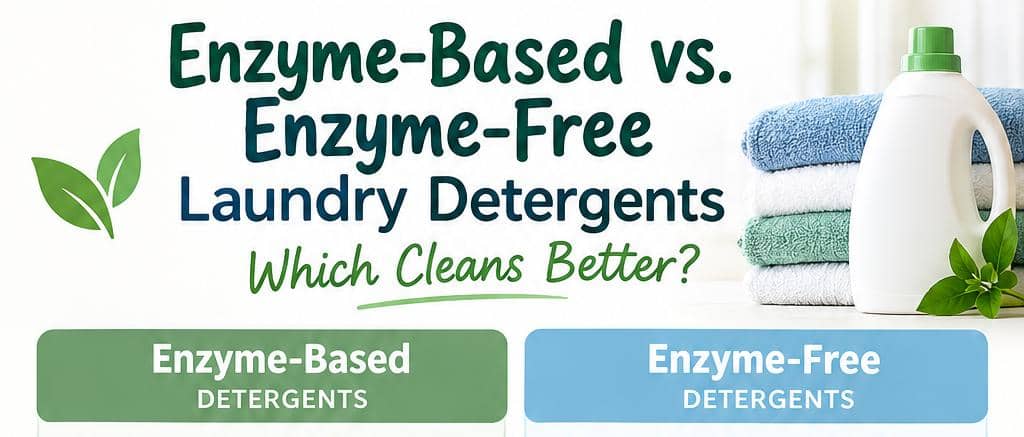
Have you ever stood in front of a shelf of laundry detergents wondering whether you should choose an enzyme-based formula or an enzyme-free alternative?
Perhaps you have sensitive skin, want to reduce your household’s environmental impact, or simply want your clothes to come out cleaner without using more detergent than necessary.
I think this is an important decision for anyone trying to build a more conscious cleaning routine. Laundry detergent labels can be confusing, especially when terms such as biological, non-biological, plant-based, and hypoallergenic appear together.
Here is what I want you to understand: enzyme-based detergents are not automatically better for every household, and enzyme-free detergents are not automatically safer or more environmentally friendly.
The right choice depends on your laundry habits, the stains you encounter, your personal preferences, and the complete detergent formulation.
Let’s look at what separates these two types of detergent and how to choose the right one for your home.
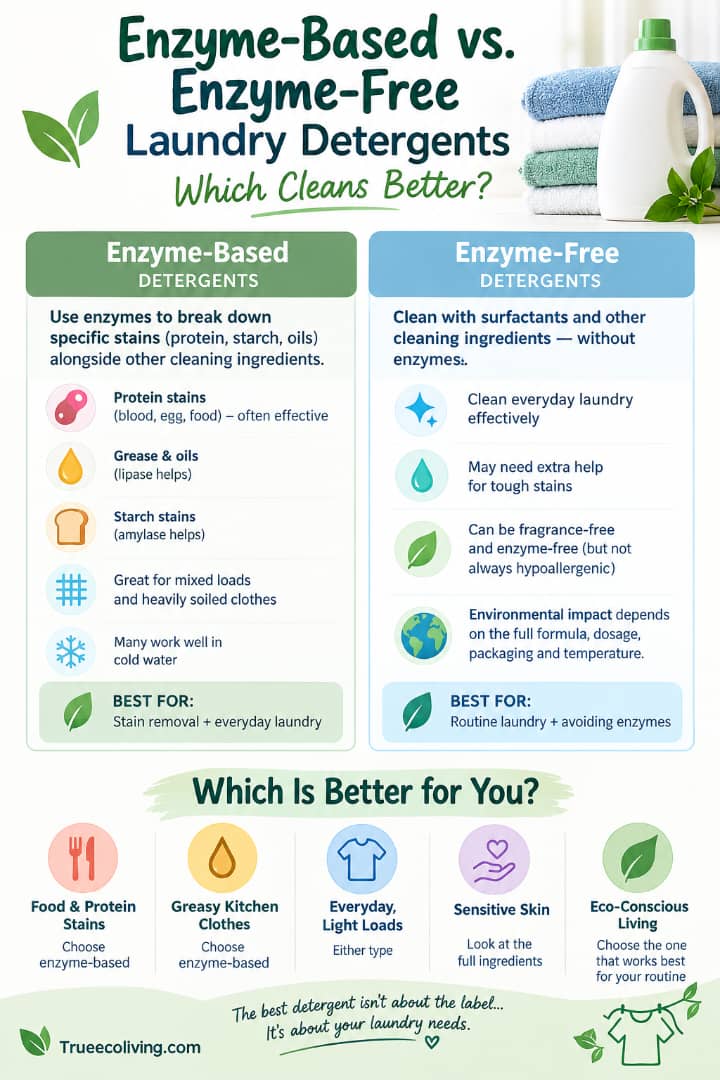
Enzyme-Based vs. Enzyme-Free Laundry Detergents: At-a-Glance Comparison
| Feature | Enzyme-Based Detergent | Enzyme-Free Detergent |
|---|---|---|
| How it cleans | Uses enzymes alongside other cleaning ingredients | Relies on surfactants and other cleaning ingredients without enzymes |
| Protein stains | Often effective against blood, egg, and food proteins | May require more pretreatment |
| Grease and oils | Enzymes such as lipase can help break down oily stains | Performance depends on the other cleaning ingredients |
| Starch stains | Amylase can help remove food-based starch stains | Some stains may require additional treatment |
| Everyday laundry | Suitable for most routine washing when used as directed | Also suitable for many everyday loads |
| Cold-water washing | Many formulations work effectively at lower temperatures | Performance varies by formulation |
| Sensitive skin | Some formulations suit sensitive-skin needs, but ingredients matter | Useful for people specifically avoiding enzymes, although other ingredients can still cause problems |
| Environmental considerations | Effective low-temperature cleaning may reduce washing energy use | Environmental performance depends on the complete formula and washing routine |
| Best suited for | Mixed loads, food stains, body oils, and heavily soiled clothing | Routine laundry and households that prefer or need an enzyme-free formula |
Important: These are general differences, not guarantees. Actual cleaning performance depends on the complete detergent formulation, washing conditions, stain type, and dosage.
What Are Enzyme-Based Laundry Detergents?
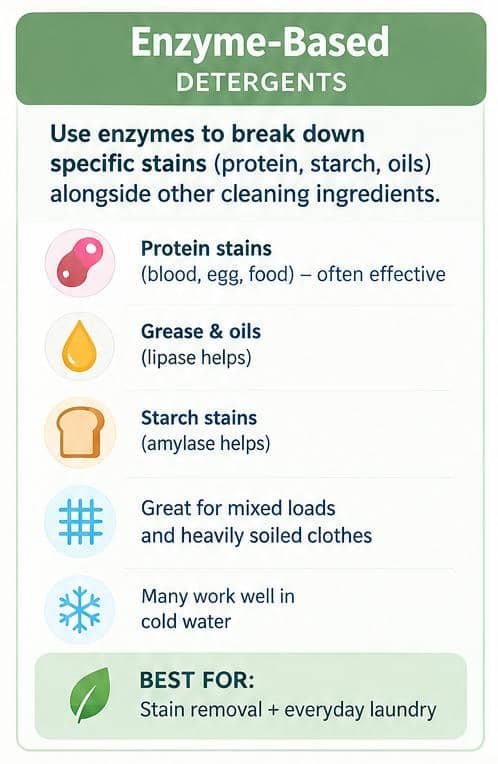
Enzyme-based detergents contain enzymes that help break down particular types of stains into smaller substances that can be removed during washing.
Think of enzymes as specialised cleaning assistants. Each performs a particular job, allowing the detergent to tackle stains that ordinary cleaning ingredients may struggle with.
According to the American Cleaning Institute’s guide to enzymes in cleaning products, different enzymes target different stain types.
Here are the main ones to understand.
Protease: Protein Stains
Protease helps break down protein-based stains, including blood, egg, and some food residues. This makes it useful for clothes exposed to food spills and other protein-containing substances.
Amylase: Starchy Food Stains
Amylase targets starch-based stains. It can help with residues from foods such as potatoes, pasta, and starchy baby food.
Lipase: Greasy Stains
Lipase helps break down fats and oils. It can be particularly useful for clothing exposed to oily food, cooking grease, and body oils.
Cellulase: Fabric Care
Cellulase acts on cellulose fibres. In some detergent formulations, it helps remove tiny cotton fibres and improve the appearance of fabrics over repeated washes.
Other enzymes, such as mannanase and pectate lyase, target additional substances found in foods and other stains.
DISCOVER: 7 Best Non-Toxic Laundry Detergents That Actually Clean Clothes
Why I Consider Enzyme-Based Detergents Practical
Imagine washing a child’s school uniform with food stains, sweaty sportswear, and everyday clothing in the same week.
An enzyme-based detergent can help address several different kinds of stains without requiring a separate product for every situation.
I also consider the potential energy savings. When a detergent cleans effectively at a lower temperature, it may allow you to use less energy for heating the wash water.
However, the enzyme itself does not guarantee a good environmental outcome. The complete formula, dosage, packaging, and washing routine still matter.
BEST ENZYME-BASED PICK
Dirty Labs Bio Enzyme Laundry Detergent, Free & Clear
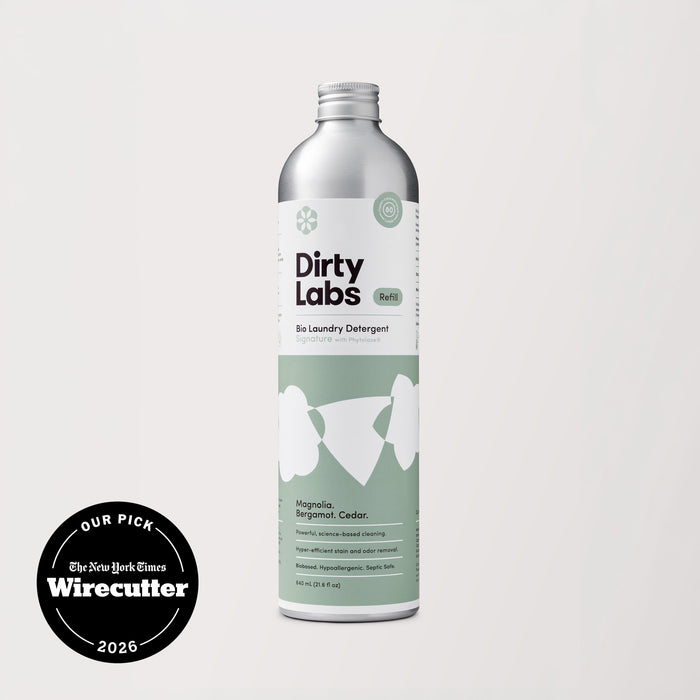
Best for: Households wanting an enzyme-based detergent for everyday laundry, food stains, and lower-temperature washing.
What makes it stand out is its combination of five types of enzymes: protease, amylase, cellulase, mannanase, and pectate lyase. These target different types of stains and residues.
The brand describes its concentrated formula as suitable for cold-water washing and traditional and high-efficiency washing machines. Its packaging also includes a recyclable aluminum bottle.
My verdict: This is a promising option for people who want targeted stain removal while considering ingredient transparency and packaging waste. Select the Free & Clear version if you prefer a fragrance-free formula.
What Are Enzyme-Free Laundry Detergents?
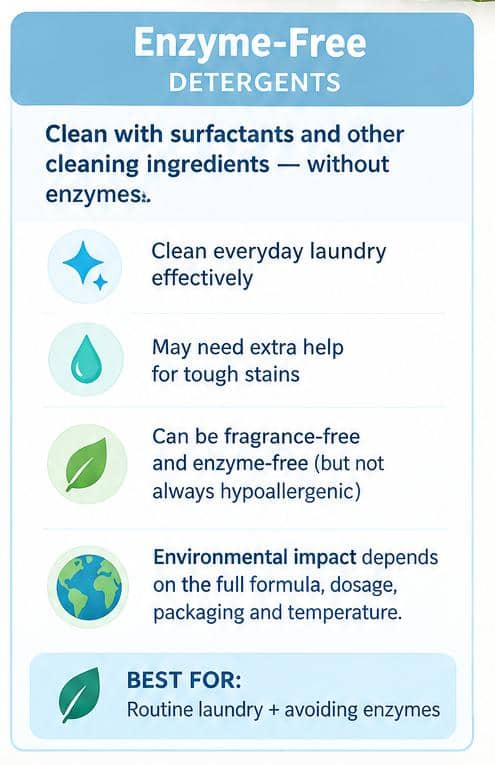
Enzyme-free detergents are formulated without added detergent enzymes.
They can still contain surfactants, water-softening ingredients, and other cleaning agents.
These ingredients help lift dirt from fabrics, disperse it into the wash water, and prevent it from settling back onto clothing.
In other words, enzyme-free does not mean cleaning-agent-free.
The main difference is that these detergents do not rely on enzymes to break down particular types of stains.
When Does an Enzyme-Free Detergent Make Sense?
I would consider an enzyme-free formula in several situations.
First, it is appropriate for households that specifically prefer to avoid detergent enzymes or have been advised to do so by a healthcare professional.
Second, it can be a sensible choice for routine laundry that is not heavily stained. Everyday clothing, lightly worn shirts, and other normally soiled fabrics may not require the additional stain-targeting action provided by enzymes.
Third, enzyme-free formulations can suit people who want a simple laundry routine with fragrance-free products.
There is one important distinction, though: an enzyme-free formula is not automatically hypoallergenic.
A detergent can contain no enzymes and still contain fragrances or other ingredients that some people find irritating.
For a more carefully considered choice, I look at the entire ingredient list rather than focusing exclusively on whether enzymes are present.
BEST ENZYME-FREE PICK
Ecover ZERO Non-Bio Sensitive Laundry Detergent

Best for: Households looking for a fragrance-free laundry detergent without enzymes.
Ecover ZERO is formulated without fragrance and enzymes. The brand also lists biodegradable ingredients, refill options, and a bottle made from 100% post-consumer recycled plastic.
I particularly like the refill approach because reducing packaging waste is an important part of building a more sustainable cleaning routine.
Its enzyme-free formulation may require more attention when washing stubborn protein or greasy food stains, so pretreating particularly dirty clothing can be helpful.
My verdict: This is a worthwhile option for people specifically seeking an enzyme-free, fragrance-free detergent. However, check local availability and the current product label before purchasing.
Which Type Is Better for Different Laundry Situations?
Rather than declaring one detergent universally superior, I recommend matching the formula to the job.
1. For Food and Protein Stains
My preference: An enzyme-based detergent.
If your laundry regularly includes food spills, egg stains, or other protein-containing residues, enzymes can provide a practical advantage.
Protease and amylase address different stain types, so a formula containing both can be particularly useful for mixed household laundry.
Remember that stain removal still depends on the formulation and how you handle the stain. An enzyme-based detergent is not a guarantee that every stain will disappear in one wash.
2. For Greasy Kitchen Clothing
My preference: An enzyme-based detergent containing lipase.
Cooking oils and greasy food residues can be challenging because they do not dissolve readily in water.
Lipase can help break down certain oily soils, while surfactants help lift and disperse the loosened residue.
For stubborn grease, follow the garment care instructions and pretreat the affected area with a suitable product when necessary.
3. For Everyday, Lightly Soiled Clothing
My preference: Either type.
If your clothing has mainly accumulated ordinary dust and light everyday soil, a well-formulated enzyme-free detergent may perform perfectly adequately.
You do not necessarily need the most complex formula for every load.
I would focus on correct dosing, avoiding an overloaded washing machine, and choosing a temperature suitable for the fabric and detergent.
4. For Sensitive-Skin Households
My preference: A formulation that addresses the household’s specific needs.
If someone in your household has a known sensitivity to an ingredient, avoid that ingredient and seek professional advice when necessary.
However, I would not assume that removing enzymes automatically solves skin irritation.
Fragrance, other detergent ingredients, and detergent residue can also be relevant. A fragrance-free formulation may be worth considering, and using the recommended amount of detergent and following the machine’s instructions can help prevent unnecessary residue.
People with persistent skin problems should speak with a qualified healthcare professional rather than relying on detergent marketing claims.
5. For Eco-Conscious Laundry
My preference: Either type, provided the overall formulation and usage make sense.
Enzyme-based detergents may help remove stains at lower temperatures. This can support an energy-conscious washing routine, particularly when the alternative would be a hotter wash.
An enzyme-free detergent may also be a good choice if it cleans effectively under your usual washing conditions.
For environmental reasons, I would compare the dosage per load, packaging materials, refill availability, and performance rather than assuming that enzyme-free products are automatically greener.
BOOKMARK: Laundry Detergent Sheets vs. Powder: Which Is Better for Cleaning, Saving Money and Reducing Waste?
Are Enzyme-Free Detergents Better for the Environment?
Not necessarily.
This is one of the assumptions I would encourage readers to question.
The environmental impact of laundry detergent depends on several factors, including how ingredients are produced, how much detergent is required, packaging, transport, and what happens during washing and wastewater treatment.
Enzymes can improve stain removal under suitable lower-temperature conditions. Washing with cooler water may reduce the energy needed to heat water, although the savings depend on the machine and wash programme.
On the other hand, an enzyme-free detergent may still be a sound environmental choice if it cleans effectively, uses a suitable amount of product, and comes in packaging that aligns with your waste-reduction goals.
My approach is simple: choose a detergent that works well at the lowest suitable temperature, measure it correctly, and avoid unnecessary rewashing.
That is more useful than choosing a product simply because its label says enzyme-free or natural.
How to Choose the Right Laundry Detergent
Before buying either type, I recommend checking five things.
Read the ingredients. Look for enzymes such as protease, amylase, lipase, and cellulase when comparing enzyme-based products. If you specifically need an enzyme-free formula, check that the current product label confirms this.
Consider the stains you encounter. Frequent food stains, oily residues, and heavily soiled clothes are good reasons to consider an enzyme-based detergent.
Check the fragrance. Fragrance-free is a separate characteristic from enzyme-free. One does not automatically mean the other.
Compare the cost per load. Concentrated detergents can require smaller doses, but always compare the recommended amount per wash rather than the bottle price alone.
Look beyond the packaging claims. Consider refill availability, recycled materials, ingredient transparency, and whether the detergent works at the temperatures you normally use.
TrueEcoLiving Verdict
After comparing enzyme-based and enzyme-free laundry detergents, my conclusion is that the best choice depends on your laundry needs, not simply on the presence or absence of enzymes.
For households dealing with food stains, body oils, and mixed loads, I generally favour a well-formulated enzyme-based detergent.
It offers additional stain-targeting capabilities and may help you clean effectively without automatically resorting to hotter washes.
For households that specifically want to avoid enzymes, an enzyme-free alternative remains a reasonable option.
I would simply pay closer attention to its overall cleaning performance, fragrance, ingredients, and whether stubborn stains need pretreatment.
From an eco-living perspective, I believe the bigger goal is to develop a laundry routine that cleans effectively while avoiding waste, unnecessary product use, and needless energy consumption.
You do not have to choose the detergent with the most impressive label. Choose one that suits your household, use it correctly, and let its actual performance guide your decision.
READ ALSO: 15 Low-Waste Laundry Tips for an Eco-Friendly Environment at Home
Enzyme-Based vs. Enzyme-Free Laundry Detergents In a Nutshell
- Enzyme-based detergents target specific stains. Different enzymes help break down protein, starch, and oily residues, making these detergents useful for everyday laundry and heavily soiled clothes.
- Enzyme-free detergents can clean everyday laundry effectively. However, some formulations may need additional stain treatment to remove stubborn food, grease, or protein stains.
- Enzyme-free does not automatically mean gentler. Fragrances, other ingredients, detergent residue, and individual sensitivities also matter.
- Both types can fit an eco-conscious lifestyle. Look at the entire formulation, recommended dosage, packaging, and washing temperature rather than relying on a single marketing claim.
- The best detergent is the one that meets your needs efficiently. For stubborn stains, an enzyme-based detergent is often a practical choice. For households specifically avoiding enzymes, an enzyme-free alternative makes sense.
Conclusion
Enzyme-based and enzyme-free laundry detergents can both play a useful role in an eco-conscious household.
Enzyme-based formulas offer targeted help with protein, starch, and oily stains. Enzyme-free formulas clean without added detergent enzymes and may suit people who specifically prefer or need to avoid them.
Neither category automatically guarantees better cleaning, gentler ingredients, or a smaller environmental footprint.
My advice is to start with your usual laundry challenges, check the complete product formulation, and choose a detergent that performs well under your normal washing conditions.
Small, thoughtful changes to your laundry routine can make a meaningful difference without making everyday cleaning unnecessarily complicated.
Frequently Asked Questions
Enzyme-based detergents often have an advantage when removing certain protein, starch, and oily stains. However, enzyme-free detergents can clean everyday laundry effectively. The better choice depends on the formulation, type of soil, washing conditions, and any specific ingredient sensitivities.
Not necessarily. Enzyme-free detergents can be useful for people who need or prefer to avoid detergent enzymes, but other ingredients can also cause irritation in some individuals. Consider fragrance-free products, follow dosing instructions, and seek professional advice if skin problems persist.
Yes, some enzyme-free detergents can remove difficult stains, but performance varies. Certain protein, starch, and greasy stains may require pretreatment or additional washing effort. Follow the garment care instructions and use a suitable stain-removal method.
Neither is automatically more eco-friendly. Enzyme-based detergents can help with lower-temperature stain removal, potentially reducing water-heating energy use. Enzyme-free detergents can also be environmentally considerate choices. Compare cleaning performance, recommended dosage, packaging, refill options, and the temperature needed for an effective wash.