
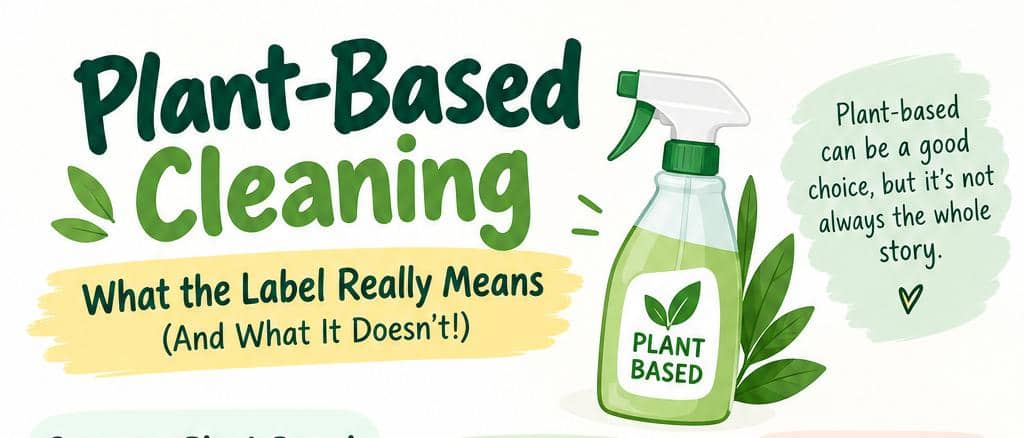
When I look at cleaning products marketed as plant-based, I understand why they appeal to people trying to create a healthier home.
The packaging often looks simple and earthy, the ingredient descriptions sound reassuring, and the promise of cleaning effectively without relying heavily on conventional ingredients is attractive.
But I have learned to look beyond the front of the bottle.
A plant-based label can tell you something useful about where certain ingredients come from, but it does not automatically tell you how safe the entire formula is, how well it cleans, or how much environmental damage it may cause.
This is where I believe conscious cleaning becomes important. Rather than choosing products simply because they look natural, I prefer to understand what goes into them, what those ingredients actually do, and where their limitations lie.
So, what does plant-based cleaning really mean? And how can you tell whether a cleaner deserves a place in your home?
Let’s explore the ingredients, labels, benefits, and less obvious limitations together.
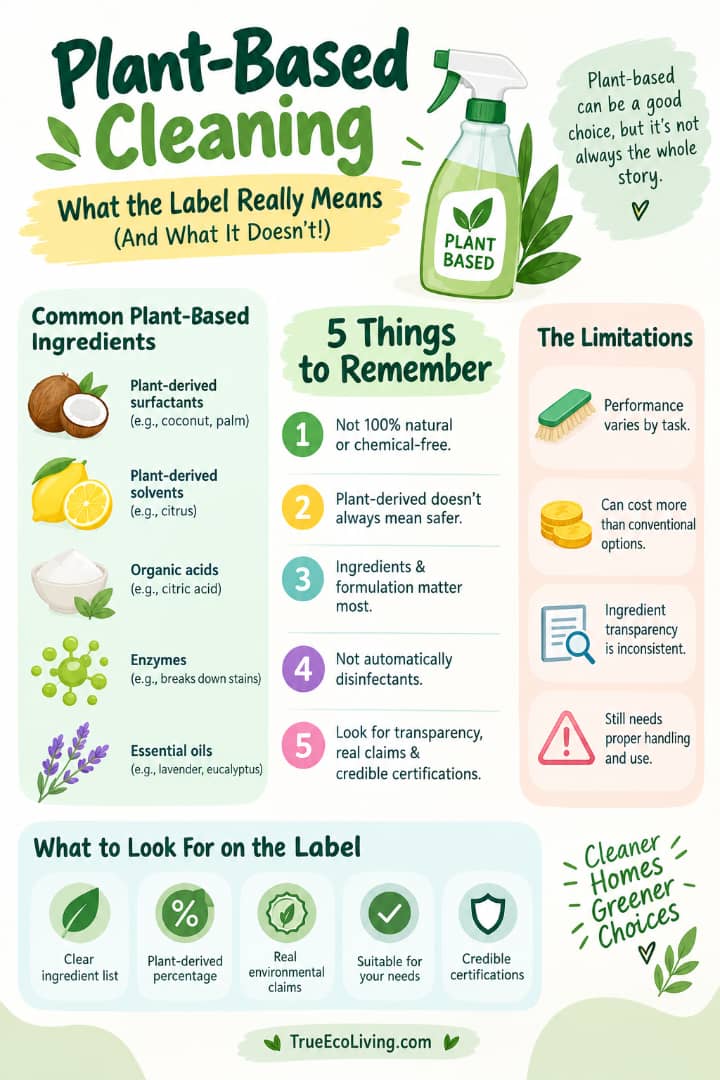
Plant-Based Cleaning: 5 Things You Should Know
- Plant-based does not mean entirely natural. A cleaner may contain ingredients derived from plants alongside water, minerals, preservatives, and other processed ingredients.
- Plant-derived does not automatically mean safer. The origin of an ingredient alone cannot tell you its potential effects on people, pets, or the environment.
- The ingredients matter more than the marketing. Surfactants, solvents, acids, enzymes, and fragrances each serve different purposes and have different limitations.
- Plant-based cleaners are not automatically disinfectants. Cleaning away dirt and grease is different from killing specific germs.
- Transparency is essential. I look for clear ingredient information, specific environmental claims, suitable performance, and credible certifications rather than relying on attractive packaging.
Plant-Based Cleaning at a Glance
| Ingredient or label | What it usually means | What I would check |
|---|---|---|
| Plant-derived surfactants | Ingredients that help lift dirt and grease | Ingredient safety and cleaning performance |
| Citric acid or other plant-derived acids | Ingredients used to dissolve certain mineral deposits | Surface compatibility and product directions |
| Plant-derived solvents | Ingredients that help dissolve grease and oily residues | Irritation potential and intended use |
| Enzymes | Ingredients that break down certain types of stains | Suitable applications and handling instructions |
| Essential oils or plant fragrances | Ingredients added for scent and sometimes specific cleaning functions | Fragrance sensitivity and evidence for any antimicrobial claims |
| Biodegradable claim | A claim that a material or product can break down under particular conditions | Testing information and the conditions required |
| Plant-based claim | One or more ingredients may come from renewable biological sources | Which ingredients are plant-derived and the percentage, if disclosed |
BOOKMARK: Fragrance-Free vs. Scented Cleaning Products: Which Is Better for Your Home?
What Does Plant-Based Cleaning Really Mean?
Plant-based cleaning generally refers to cleaning products that contain ingredients sourced wholly or partly from plants or other biological materials.
These sources may include corn, sugarcane, coconut, palm, citrus fruits, and other agricultural materials.
Manufacturers can process these raw materials into surfactants, solvents, and other functional ingredients used in cleaning formulations.
Here is an important distinction I want you to understand: an ingredient can originate from a plant and still undergo substantial chemical processing before it becomes useful in a cleaner.
That is not necessarily a problem. In fact, processing is often what makes the ingredient effective at removing dirt.
I do not judge a cleaning ingredient simply by whether it has been processed. Instead, I consider what the ingredient does, how it behaves in the finished formula, and what evidence is available about its safety and environmental impact.
Another thing worth understanding is that plant-based is not necessarily the same as 100% plant-derived.
A product might use one plant-derived surfactant while containing other ingredients from different sources.
Unless the manufacturer specifies the percentage of plant-derived content, the label alone may not tell you how much of the formula comes from plants.
This is why I treat plant-based as a useful starting point rather than a complete assessment of a cleaning product.
Which Ingredients Are Common in Plant-Based Cleaning Products?
Understanding the ingredients makes it easier to separate meaningful product information from marketing language.
1. Plant-derived surfactants
Surfactants are among the most important ingredients in many cleaning products. They help water interact with oily dirt, making it easier to loosen and remove grime from surfaces.
Some surfactants can be manufactured using plant-derived fatty alcohols and sugars. Coconut, palm, and corn-derived feedstocks may be involved, depending on the ingredient and manufacturing process.
I pay attention to surfactants because the source tells only part of the story. Their chemical structure, concentration, biodegradability, and effects on aquatic organisms are also important.
A plant-derived surfactant can be an effective choice, but its plant origin alone does not establish that it is harmless.
2. Plant-derived solvents
Solvents help dissolve grease, oils, and other residues that water alone may struggle to remove.
Depending on the formulation, manufacturers may use ingredients derived from plant materials, including certain citrus-derived compounds.
These ingredients can be useful in kitchen degreasers and other products designed to tackle oily messes.
However, I would not automatically assume that a citrus-derived solvent is gentle on skin or suitable for every household surface. Some solvents can irritate the skin or eyes, and some fragrance-related ingredients can cause sensitivity.
The finished formula and its directions matter more than the appealing source of an ingredient.
3. Organic acids
Citric acid, lactic acid, and acetic acid are examples of acids that may appear in cleaning products.
They can help remove certain mineral deposits, including some hard-water marks and limescale. Their usefulness depends on the formulation, the type of residue, and the surface being cleaned.
I particularly encourage people to think about surface compatibility before choosing an acidic cleaner.
For example, acidic products can damage some natural stone surfaces, including marble. A cleaner that works well on a compatible bathroom fitting may not be appropriate for every countertop.
And remember, an acid’s ability to dissolve mineral buildup does not automatically make it a disinfectant.
4. Enzymes
Enzymes are used in some cleaning products because they help break down particular types of organic soil.
Different enzymes target different materials. Proteases act on proteins, amylases act on starches, and lipases help break down fats.
You may encounter them in laundry detergents and other specialized cleaners.
I consider enzymes useful when a product is designed for a particular cleaning job. However, they are not universal stain removers. Results depend on the stain, formulation, temperature, and instructions.
Some enzyme ingredients can also irritate sensitive skin or the respiratory system, particularly in occupational settings or when products create airborne droplets. Follow the product’s handling instructions rather than assuming that a biological ingredient is automatically harmless.
5. Essential oils and plant fragrances
Lavender, eucalyptus, lemon, and other plant-derived scents are common in products positioned as natural or plant-based.
I understand why fragrance makes cleaning more enjoyable for many people. Still, a pleasant smell is not evidence of better cleaning performance or improved indoor air quality.
Essential oils and other fragrances can trigger irritation or allergic reactions in some people. Certain plant-derived fragrance compounds can also cause sensitization.
I also avoid assuming that a product disinfects simply because it contains an essential oil with antimicrobial properties in laboratory studies. A finished household product needs suitable evidence for the particular germ-killing claim being made.
For households that prefer to minimize fragrance exposure, I would look for a genuinely fragrance-free formulation rather than relying on words such as natural scent or botanical fragrance.
Are Plant-Based Cleaning Products Safer?
This is one of the biggest questions I consider when choosing cleaning products.
My answer is that they can be a sensible option, but the label alone is not enough to establish safety.
A plant-derived ingredient may have a favorable safety profile for its intended use. Another plant-derived ingredient may cause irritation or other concerns under certain exposure conditions. The same is true of ingredients from mineral or petroleum sources.
I look at several factors together: the ingredient’s hazard profile, how much is present, how people are likely to be exposed, how the product is used, and whether the formulation has been evaluated appropriately.
I also distinguish between safer and harmless.
A product that has been assessed against meaningful safety criteria may be a better choice for its intended use, but that does not mean it should be swallowed, allowed to contact the eyes, or used contrary to its directions.
One useful benchmark is the U.S. Environmental Protection Agency’s voluntary Safer Choice program. It assesses ingredients and other product characteristics, including performance, pH, packaging, and volatile organic compounds.
Importantly, Safer Choice is not simply a plant-based certification. Its value is that it evaluates broader safety and product criteria instead of relying only on ingredient origin.
I see this as a more informed approach to conscious cleaning: look for evidence about the finished product, not just reassuring words on the packaging.
What Plant-Based Labels Do Not Tell You
This is where I believe careful label reading makes the biggest difference.
Plant-based does not mean chemical-free
Everything made of matter, including water and plant extracts, consists of chemicals. Therefore, chemical-free is not a meaningful description of an ordinary cleaning product.
What matters is which substances are present, how they function, and what is known about their effects.
I find it more useful to ask whether a manufacturer provides clear ingredient information than to look for a product advertised as free from chemicals.
Plant-based does not mean biodegradable
Biodegradability describes the ability of a material or product to break down through biological processes under particular conditions.
A plant-derived ingredient is not automatically biodegradable under every environmental condition. Even when individual ingredients biodegrade, that does not establish that every component of the finished formula breaks down quickly or completely.
When a brand makes a biodegradable claim, I look for specific information about what was tested and the conditions under which degradation occurs.
Plant-based does not mean environmentally harmless
Plant-based ingredients may come from renewable sources, but their environmental footprint depends on more than the raw material.
Growing crops can involve land use, water, fertilizer, and energy. Manufacturing, transportation, packaging, and wastewater disposal also contribute to the overall impact.
For instance, the fact that an ingredient comes from a crop does not tell you whether that crop was grown responsibly or whether its production contributed to habitat loss.
I therefore consider both ingredient sourcing and the rest of the product’s life cycle. Concentrated formulas, appropriate dosing, refill systems, and reduced packaging may offer additional benefits, depending on how they are designed and used.
Plant-based does not mean it cleans everything
Some plant-based cleaners work well for everyday dirt and grease. Others are designed for more specialized jobs.
No single formulation should be expected to remove every type of stain, dissolve every mineral deposit, clean every surface, and disinfect every area.
I always match the product to the task. A product’s performance claims and use instructions tell me far more than whether its label features leaves or citrus fruits.
How I Read Plant-Based Cleaning Labels
When assessing a plant-based cleaner, I focus on five practical questions.
1. What does the product actually contain?
I look for an ingredient list that identifies the ingredients clearly. If the label offers little information, I check whether the manufacturer provides a more detailed list online or will answer questions about the formula.
Ingredient disclosure requirements vary by country and product category, so the amount of information available can differ across markets.
2. What percentage is plant-derived?
I look for a specific percentage and an explanation of whether it refers to the whole formula or selected ingredients. A claim about plant-derived surfactants is not the same as a claim that the entire product is plant-based.
3. What does the environmental claim really mean?
Words such as green, eco-friendly, and natural can sound reassuring without explaining a measurable benefit.
I give greater weight to specific, substantiated claims and credible standards that match my concerns.
4. Is the product suitable for the task and surface?
I check whether the cleaner is made for glass, tile, laundry, grease, or another particular job. I also follow its dilution, application, rinsing, and contact-time instructions.
5. Does it suit my household’s needs?
I consider fragrance preferences, ventilation, storage, surface compatibility, and the needs of anyone who may come into contact with the product.
And one important reminder: never mix cleaning products unless their instructions explicitly permit the combination. Some mixtures can release dangerous gases or cause other harmful reactions.
LEARN MORE: How to Read a Cleaning Product Ingredient List Like a Pro (7 Things Most People Miss!)
What Are the Limitations of Plant-Based Cleaning?
I believe conscious consumers benefit from understanding these limitations before making a purchase.
First, performance varies. A plant-based all-purpose cleaner may be excellent for routine wiping but unsuitable for stubborn mineral deposits or a specialized cleaning task.
Second, some formulas cost more than conventional alternatives. Whether the extra cost is worthwhile depends on the ingredients, performance, concentration, packaging, and the benefits the product actually delivers.
Third, ingredient transparency can be inconsistent. Two products with similar front-label claims may reveal very different amounts of information about their composition.
Finally, plant-based products still need to be handled properly. They can cause irritation, damage unsuitable surfaces, or fail to achieve a desired result when used incorrectly.
My approach is not to dismiss plant-based cleaners because they have limitations. It is to understand those limitations so I can select products more thoughtfully.
TrueEcoLiving Verdict
I consider plant-based cleaning a promising part of a more conscious household routine, but I would never treat the label as proof that a product is automatically safer, greener, or more effective.
What matters to me is the combination of ingredient transparency, appropriate performance, responsible sourcing, suitable packaging, and credible safety or environmental evidence.
I also believe we can make meaningful improvements without replacing every cleaner in our homes overnight. Start with the products you use most often.
Read their labels, reconsider heavily fragranced options if fragrance is a concern, avoid unnecessary overuse, and choose products that perform well for their intended tasks.
Most importantly, do not confuse plant-derived with risk-free. Plants provide valuable raw materials, but responsible cleaning still depends on chemistry, formulation, exposure, and how a product is used.
My final thought: The best plant-based cleaner is not necessarily the one with the greenest bottle or the most botanical ingredients.
It is the one whose ingredients and claims you can understand, whose performance meets your needs, and whose overall impact you have good reasons to trust.
Frequently Asked Questions
Not automatically. Some plant-based cleaners may offer useful environmental or ingredient-sourcing benefits, but those advantages depend on the formulation and manufacturing process. I compare products based on their ingredients, safety information, performance, and broader environmental impact rather than their labels alone.
They should not be assumed safe simply because their ingredients come from plants. Some formulations can irritate the skin or eyes or cause harm if swallowed. Choose products appropriate for the intended use, follow the directions, and store all cleaning products securely out of children’s and pets’ reach.
Some products may be formulated and tested to disinfect, but being plant-based does not establish that a cleaner kills germs. Check for an appropriate disinfectant claim, the organisms covered, and the required application and contact time. An ordinary cleaner should not be treated as a disinfectant without supporting evidence.
Start with a clear ingredient list, specific information about plant-derived content, substantiated environmental claims, and evidence that the product performs its intended task. I also recommend checking surface compatibility, fragrance information, packaging, and credible certifications relevant to your priorities.