
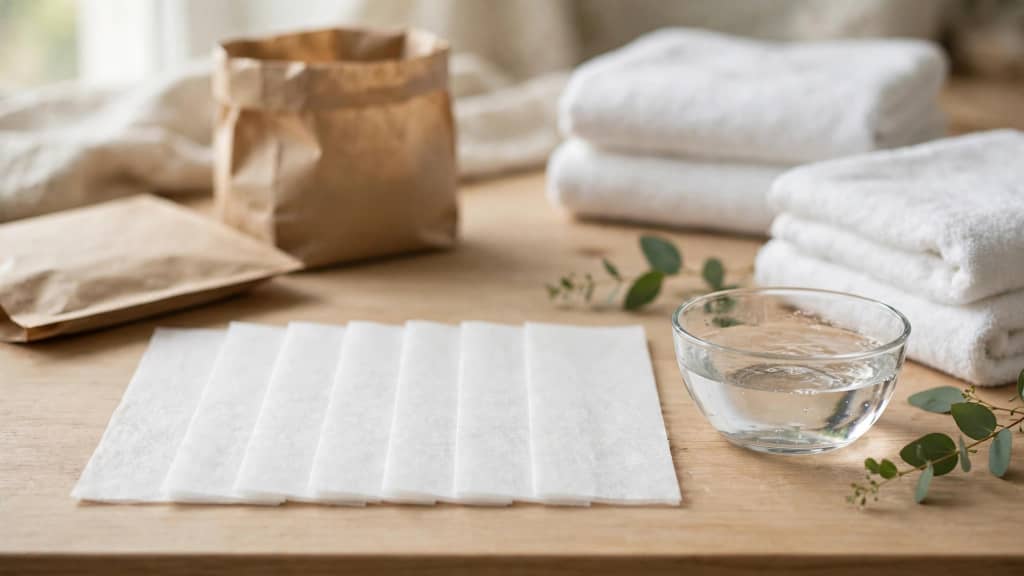
Laundry detergent sheets are often advertised as an eco-friendly alternative to bulky plastic detergent bottles. They are lightweight, convenient, easy to store and frequently marketed as plastic-free. But there is one ingredient that deserves a closer look: polyvinyl alcohol (PVA).
When I started looking more closely at the ingredients behind convenient cleaning products, I realised that a product can have less packaging without necessarily being completely plastic-free.
PVA is a good example of why I encourage people to look beyond marketing claims and read the ingredient list.
So, is PVA in laundry detergent sheets actually plastic? And should environmentally conscious households avoid it? Let’s look at what the science tells us.
What Is PVA in Laundry Detergent Sheets?
Polyvinyl alcohol, commonly called PVA or PVOH, is a synthetic, water-soluble polymer. It is used in several household and industrial products because it can form films, bind ingredients together and dissolve in water.
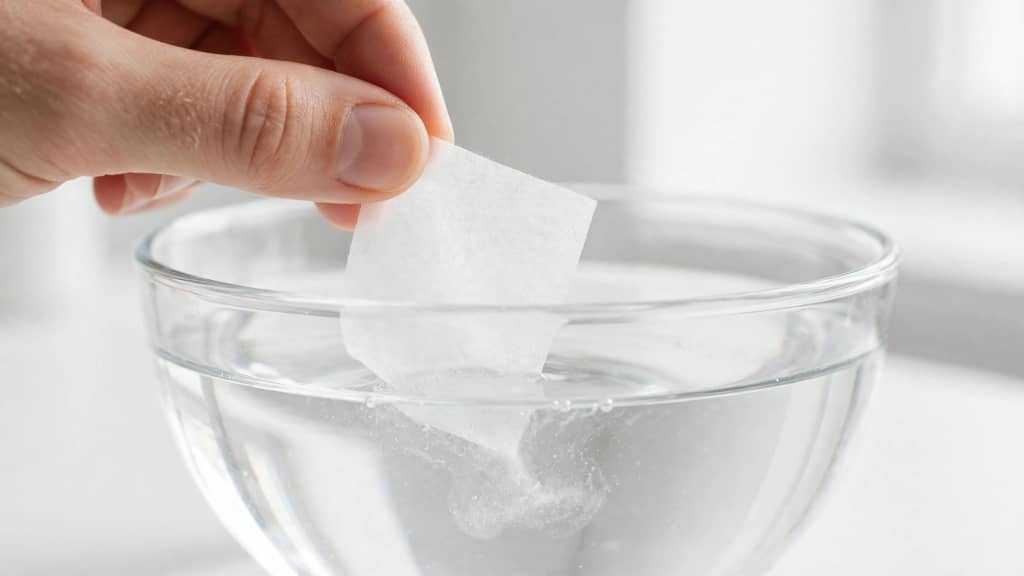
In laundry detergent sheets, PVA can act as a binder or soluble carrier. It helps hold the cleaning ingredients together, giving the detergent its thin, flexible sheet shape. When you put the sheet into water, the PVA helps it dissolve and release the detergent ingredients.
This is slightly different from laundry pods. Pods commonly use PVA as an outer dissolvable film, while some detergent sheets incorporate it into the actual sheet formulation.
I always recommend checking the actual ingredient list because not every detergent sheet has the same formulation. Look for names such as polyvinyl alcohol, PVA or PVOH.
Is PVA Technically Plastic?
Yes. PVA is a synthetic plastic polymer. However, it behaves differently from the familiar plastics used in shopping bags, bottles and food packaging.
Traditional plastics are generally designed to maintain their solid form for a long time. PVA used in detergent applications is specifically formulated to dissolve in water.
This distinction matters. Calling PVA plastic does not automatically mean it behaves like a conventional plastic wrapper or that it remains as a solid microplastic particle after washing.
My concern is not simply that PVA is synthetic. I also want to understand what happens to it after it leaves the washing machine. That brings us to an important difference between dissolving and biodegrading.
Does PVA Dissolve or Actually Biodegrade?
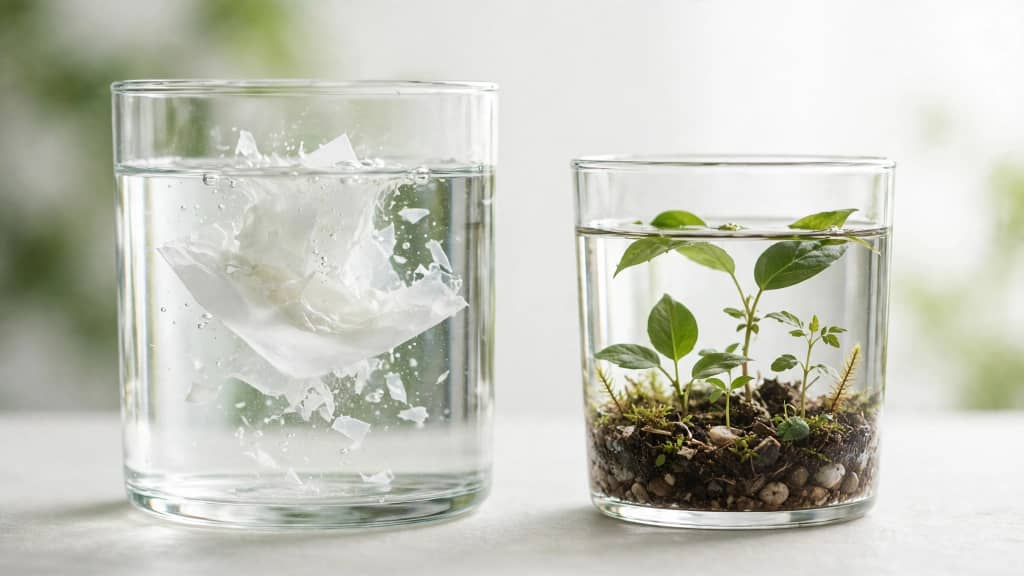
These two terms are often used interchangeably in product marketing, but they do not mean the same thing.
Dissolving means a substance disperses into water. It may no longer be visible, but that alone does not prove that microorganisms have broken it down.
Biodegrading means microorganisms break down a material through biological processes. Under suitable conditions, this can eventually result in simpler substances such as water and carbon dioxide.
For me, this is where responsible environmental research becomes more important than a simple claim saying that a detergent sheet dissolves completely.
READ ALSO: Enzyme-Based vs. Enzyme-Free Laundry Detergents: Which Cleans Better?
What Does the Scientific Evidence Say About PVA?
There has been considerable discussion about whether PVA from laundry products remains in wastewater or breaks down during treatment. Some research has raised environmental concerns, while other studies have found that particular detergent-grade PVA materials biodegrade effectively.
In its April 2023 assessment, the US Environmental Protection Agency (EPA) reviewed scientific evidence relating to specific PVA structures used in Safer Choice-certified products. It identified OECD-standardised research showing that four detergent-related PVA structures achieved more than 75% carbon dioxide evolution after 28 days and more than 87% after 60 days. These results met the relevant test criteria for ready biodegradability.
The EPA also explained why some earlier findings about PVA persistence were not necessarily representative of the soluble PVA structures used in these cleaning products. Different grades and chemical structures can behave differently.
However, I would not turn this evidence into an unlimited claim that every PVA-containing detergent sheet is 100% biodegradable or environmentally harmless. Laboratory findings for particular materials do not automatically describe every product, wastewater facility or natural environment.
The important takeaway is that detergent-grade PVA has evidence supporting biodegradation under tested conditions, but the exact formulation and disposal environment still matter.
Does PVA in Laundry Sheets Create Microplastic Pollution?
This is one of the most common concerns I encounter when discussing plastic in laundry products.
PVA is a synthetic polymer, but that does not automatically make dissolved detergent-grade PVA equivalent to the solid microplastic fragments and fibres released from synthetic materials.
Detergent-grade PVA is designed to dissolve, and the EPA’s assessment found that the specific structures it reviewed were not considered persistent, bioaccumulative and toxic under its Safer Choice criteria.
Still, I think consumers should be cautious about broad environmental claims. A product containing a synthetic polymer should not be advertised as completely plastic-free without properly explaining what is in it.
My Premium Laundry Recommendation: MEEALL Washing Bag
Reducing plastic in your laundry routine is not only about detergent. Synthetic clothing can release tiny plastic fibres during washing. The MEEALL Washing Bag is a reusable laundry accessory designed to reduce fibre breakage and catch fibres released by synthetic garments.
Why I would consider it: It is reusable, helps protect clothing and provides an additional way to reduce textile microfibre pollution.
Check the MEEALL Washing Bag on Amazon
Important: This bag targets textile microfibres. It does not filter dissolved PVA from detergent sheets. Amazon prices and availability may vary.
Affiliate disclosure: This recommendation may contain an affiliate link. I may earn a commission from qualifying purchases at no additional cost to you.
DISCOVER: 15 Low Waste Laundry Tips for an Eco-Friendly Environment at Home
Should You Avoid Laundry Detergent Sheets Containing PVA?
My answer is that you do not necessarily need to avoid every detergent sheet containing PVA. The decision depends on your priorities.
If your main goal is to reduce bulky plastic detergent bottles, a well-formulated detergent sheet with minimal packaging may still be worth considering. However, if your priority is avoiding synthetic polymers altogether, a PVA-free detergent powder in genuinely plastic-free packaging may better match your preferences.
Before buying, I suggest checking these things:
- Read the complete ingredients: Check whether PVA or PVOH is included.
- Ask about biodegradability testing: Look for specific test methods and results rather than vague promises.
- Check the packaging: Paper packaging is useful only when it is genuinely recyclable or compostable in your local system.
- Consider fragrance: Fragrance-free formulations may be preferable for households sensitive to added scents.
- Compare the full product: Consider cleaning performance, ingredients, packaging and the amount needed per load.
TrueEcoLiving Verdict
After looking at the chemistry and available environmental research, my conclusion is that PVA is technically a synthetic plastic, but detergent-grade PVA is not the same as conventional plastic packaging or solid microplastic particles.
There is scientific evidence that particular detergent-grade PVA structures can biodegrade under suitable wastewater treatment conditions.
That is encouraging, but it does not justify describing every PVA-containing laundry sheet as completely plastic-free or harmless to the environment.
Personally, I believe the better approach is informed purchasing rather than fear-based shopping.
I would rather choose a transparent manufacturer that discloses its ingredients and supports its environmental claims with evidence than rely on a beautiful green label.
5 Things to Remember About PVA in Laundry Detergent Sheets
- PVA is a synthetic, water-soluble plastic polymer.
- It can act as a binder or carrier in laundry detergent sheets.
- Dissolving and biodegrading are two different processes.
- Research supports the biodegradability of particular detergent-grade PVA structures under tested conditions.
- Always check ingredients, packaging and the evidence behind environmental claims before buying.
READ MORE: 8 Ways to Build a Low-Waste Laundry Routine Without Buying More Products
Conclusion: Is PVA in Laundry Detergent Sheets Plastic?
Yes, PVA is technically plastic, even though it is water-soluble and behaves differently from conventional plastic materials.
The good news is that specific detergent-grade PVA structures have demonstrated biodegradability in scientific tests.
For me, sustainable living is about making better decisions with the information available, not chasing products that simply look environmentally friendly.
Read the ingredients, question broad claims and choose products that match your household’s priorities.
That is how I approach a more thoughtful and genuinely eco-conscious laundry routine.
Reference
For the regulatory assessment and scientific discussion of detergent-grade PVA, see the US Environmental Protection Agency’s 2023 assessment of polyvinyl alcohol under the Safer Choice programme.
Frequently Asked Questions
Yes. Polyvinyl alcohol is a synthetic plastic polymer. However, detergent-grade PVA is water-soluble and behaves differently from conventional solid plastics and microplastic fragments.
Specific detergent-grade PVA structures have demonstrated ready biodegradability in standardised scientific tests. However, results depend on the PVA grade and testing conditions, so consumers should not assume every formulation behaves identically.
Not necessarily. If a detergent sheet contains PVA or PVOH, it contains a synthetic polymer. A brand should not describe the entire product as completely plastic-free without clearly explaining this ingredient.
You can compare PVA-free laundry powders, concentrated detergents and refill products with transparent ingredient lists. Consider the packaging, cleaning performance and environmental claims alongside the ingredients.
About the Author
Agboola Elizabeth writes about non-toxic cleaning and eco-friendly living at TrueEcoLiving. She is passionate about helping readers understand household ingredients, make informed purchasing decisions and adopt practical habits that are kinder to their homes and the environment.